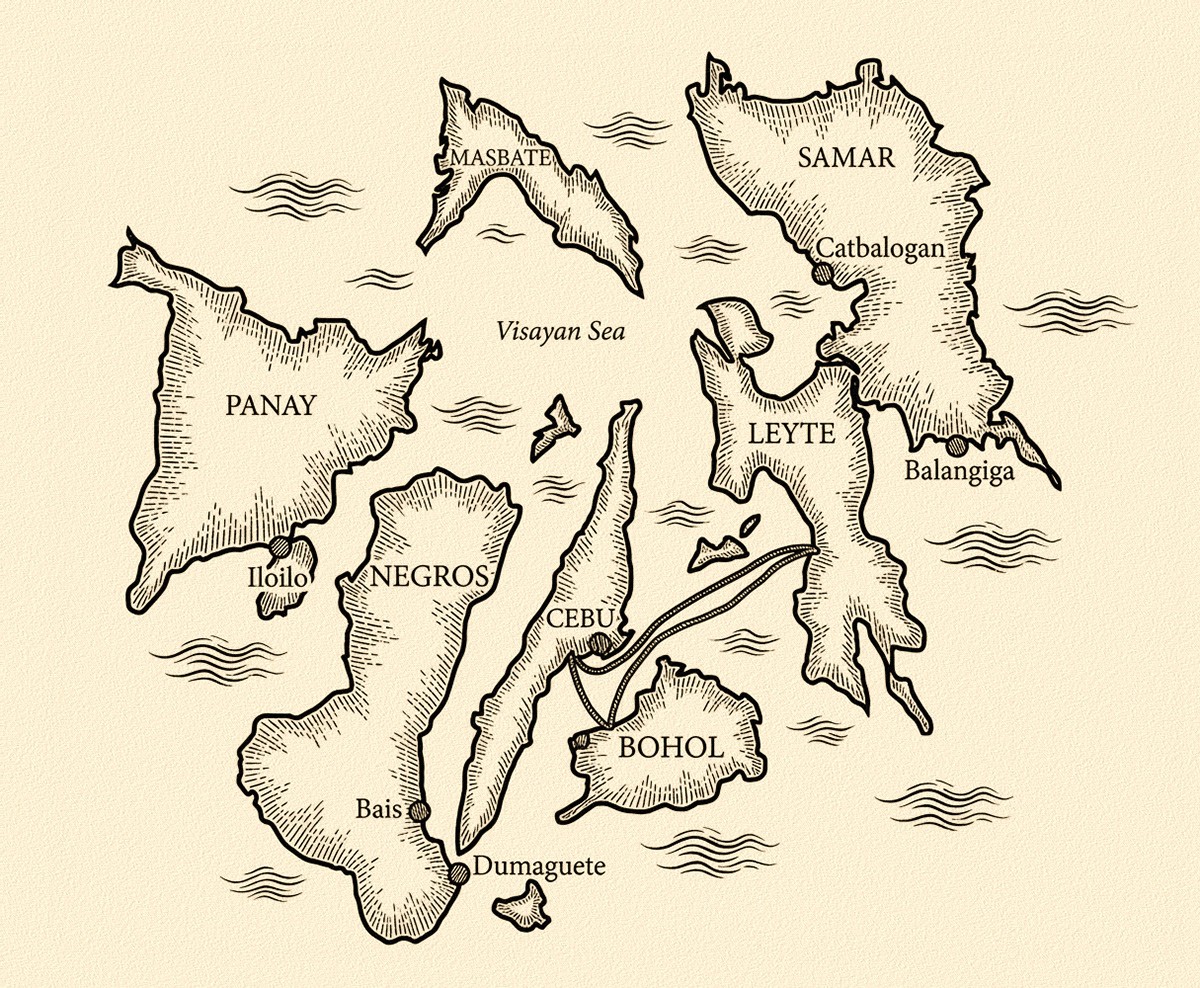
The map above shows the routes from Talisay, Cebu to Tubigon, Bohol, to Baybay, Leyte and from Talisay to Baybay. Baybay was the ancestral home of the Morazas and the place of safety during the war for many in the Aboitiz-Moraza clan.
Maria Luisa Aboitiz Canova
3rd Generation, Ramon Aboitiz branch, from her 1995 and 2019 interviews
I remember I wanted to go to college in the States and my father knew the ambassador or high commissioner in Manila. Of course, my father and this man, they were very good friends. He asked him if this would be a good time and he said, “Not at all. Do not let her go. Don’t let her go. Things are getting very tough right now.” Things were boiling and happening. I tried and my dad said to me, “If you can fix it, if you can get the papers, you may go.” Of course, he wasn’t going to give me his blessing. I never did get to go to college because, shortly afterwards, is when the war started in the Far East.
I was maybe seventeen at that time and was trying to get ready for college. I had to have the beginning of college in Santa Teresa, just a few months. But things were getting hot at that time and things were not good. Soon after, the war broke out in the Far East. It was already going on in Europe and then it broke out here. That’s when they bombed Hawaii.
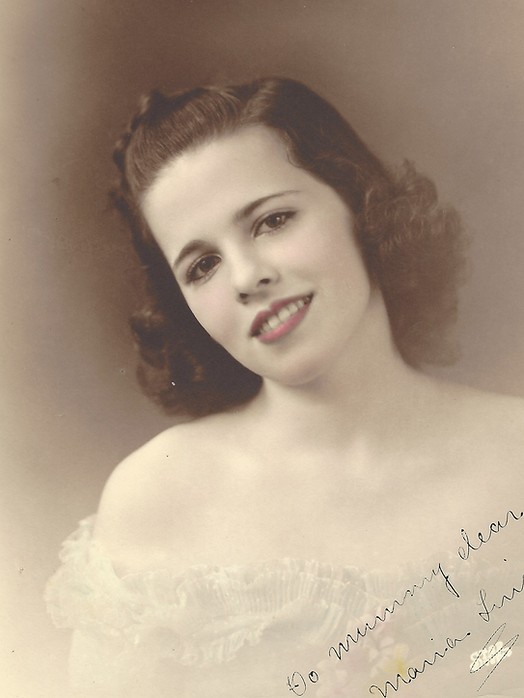
Maria Luisa Aboitiz Canova
It was at that time when they bombed Pearl Harbor and I remember very clearly being on the phone, an old-fashioned phone with the ringer, and somebody called and said that the war in Hawaii has began and that’s the beginning. Things were happening very fast and we were losing ground all the time. We depended a lot on Voice of America because that’s where we really got the news during the war. As things got worse, it finally ended up that they lost the Philippines. All that business happened in the Philippines when they had to leave and Manila was burning. The warehouses in Cebu were all opened up so people could come and get whatever they wanted. The war was on and we stayed in our house and we eventually built a shelter we would go to. But during the actual landing, we went up the hills in Busay and watched the Japanese ships come in. It didn’t take very long. The Filipinos gave up right away.
The Japanese ships, they came in and the Filipinos took off for the mountains right away and then the war was on. Everybody was biting their nails thinking what’s going to happen now. The Japanese took over and we were under them for three years.
We went to Busay to see the landing, believe it or not, because it just happened very quickly. The Americans left. I had two friends that were American supply officers, navy officers, and they came by our house for some reason and they stayed around and they said, “If we disappear all of a sudden, it’s because submarines have taken us out.”
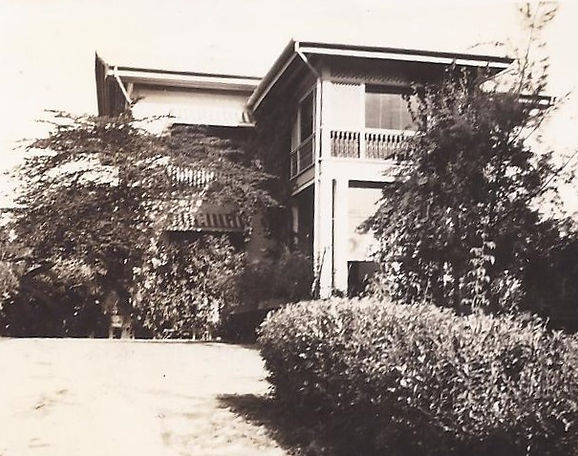
House of Ramon and Lolita Aboitiz
So then the Japanese were in and we were shocked. No water, no electricity for three years. We lucked out because we had a pump at the end of our driveway and we could get water from there, but we were very limited. The maids would go there, pump water and in five-gallon gasoline tin cans and they would put it on their head and bring it to the house. That’s how we got water. And we were super-rationed. We would stand on a basin and take a little shower and that was the dirty water for the toilet. They called it the grey water for the toilet. The clothes, how they were washed - they took them to the well by the end of the house. They took them there to wash them and then brought them to the house.
At six o’clock, there were no lights, we had to have the windows all covered with black cloth and closed up and went to sleep. There was nothing else to do. In the morning when the sun came up, we woke up. Nana and Abuelito would go to church everyday during the war. They woke up and they walked to church.
The thing is that we, in many ways, were lucky because they never did anything to us. Not at all. When they came in the house the first time, they came in with their boots dirty from being out in the fields and they walked right in. We had decided to let them have the downstairs and we would move upstairs. They thought we would move out, which a lot of people did and lost their houses. They came in and Nana (Lolita Sidebottom Aboitiz) was never afraid of them. She was something else. She was never afraid of the Japanese at all, little as she was.
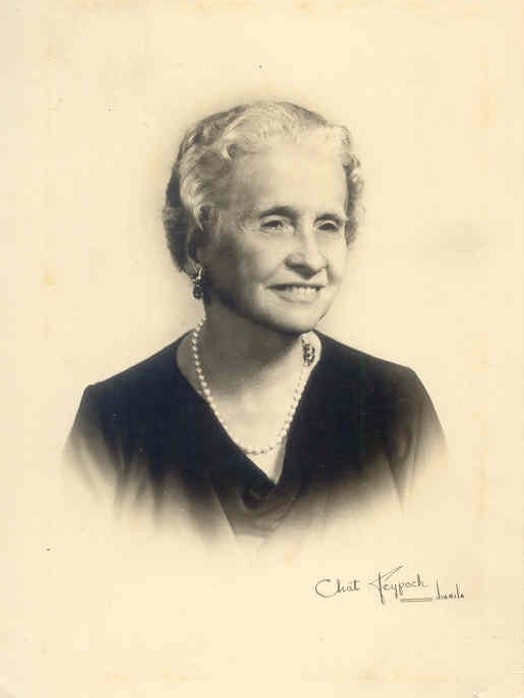
Lolita Sidebottom Aboitiz
She got a hold of them one day and she said, “I have been to Japan many times. In Japan, you don’t come in the house with shoes on. So please, this is my house. Leave your shoes outside.” And they did. They said, “Yes, Mama-San.” They called her Mama-San. And then she said, “And what’s more, you’ve left my nice wood floors all dirty. The maids here will teach you how to clean that.” And they cleaned it with their bare hands. “And then, they will teach you how to use a bunot (coconut half shell to polish the floor) and I want you to leave it the way it was.” She did. Dad would say, “My God, I’ll build you another house when the war is over but just let them do what they want.” She said, “No, this is my house. They have to do what I want.” She was not afraid. They put their bayonets on top of the grand piano we had and she said, “You never do this. This is a very expensive piece of furniture. Don’t do that. Here’s a blanket.” It was an army blanket of some sort. “Put that on top and then you can put your guns on but not without anything underneath.” And they did it.
We used to make paella on Sundays. One chicken was good enough for maybe fourteen or fifteen people. We just added more rice to make a paella of some kind with whatever vegetables we could get, baked beans, and whatever. The Japanese made their own food, but when they saw us doing that outside - we had no electricity and we had to cook, many of the things we cooked, we cooked outside - one day, they decided, “Ah so, we can make that, ah so.” So they put ketchup in their rice and they put all kinds of whatever they had, some kind of canned fish and they would stir it up and then they would present it to us with some of that rice they had made.
They would give my mother all kinds of gifts, like pink silk stuff and a baby dress. They liked her, basically. Then when the Filipinos had cuts and sores, they would come because they had no medicines, and my mother would help and we would make do with whatever we had, Mercurochrome or anything we had to help them. Some of these people had big, big sores. Then the Japanese wanted to be cured, too. They would go to my mother and say, “Mama-San, help us” because they had sores too. My mother would put food coloring in the alcohol and they never complained. It must have been so painful and somebody told us after a while that we were doing them a favor. Alcohol, at least, would disinfect something. They all came over and they wanted to be cured.
They were strange times, strange times. We cooked with whatever there was and, I mean, the best chocolate cakes I have ever made in my life were with old flour that had weevils but we sifted them out. We had no milk so we used coconut milk and we had no shortening or anything like that so we used a lot of lard, lots of it. And they were wonderful cakes! They really were good. We did have sugar but we had no butter. If we wanted to keep meat, we would put it in saltpeter. You can imagine what that did to all the guys.
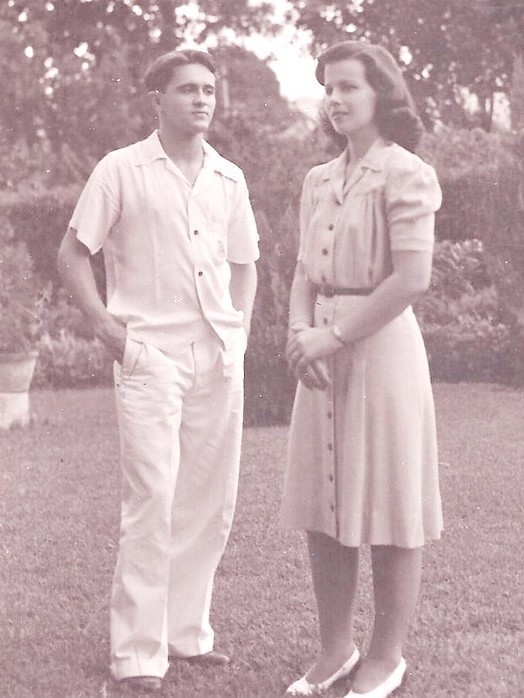
Eddie and Maria Luisa Canova
That’s what happened during the war, but we lucked out. Eddie was caught one time. They used to go to bars, Baring and Eddie even if there was curfew. They were almost caught but they managed to get away. The Japanese weren’t really killing people in Cebu, but they would take people. The boyfriend I had then, Anatol, who my parents hated because he was not a nice guy, the Japanese took him and they brought him to the house. That’s why I think they were kempetai because they were torturing him in the house. They caught him out in the streets near a bar and they brought him to the house and my mother and dad said, “Oh poor Anatol.” “And you don’t like him.” “Yup but we don’t want to see him being tortured.” They did it all in our house. I don’t know what they did to him. We couldn’t see that. They were tough times, but we survived.
They didn’t do the atrocities in Cebu like they did in Manila. They didn’t. The only real atrocity that I remember was a girl that I knew that she would not cooperate with them or something and they took off all her toenails. After it was over, she could not even stand next to you. They cut off her nails because there was something they wanted her to do and she wouldn’t do it.
Later on, as the Americans started coming back and things were getting really rough, Abuelito and Tio Vidal said, “Everyone has to do now what they need to do. Every family has to decide what they want to do.” Some went to Baybay and this is where Maria (Montenegro) Aboitiz was pregnant and Vicki ended up being born in Baybay. They went in a banca with water coming in but Tia Maria was a very brave woman. They went there because she had children, smaller children.
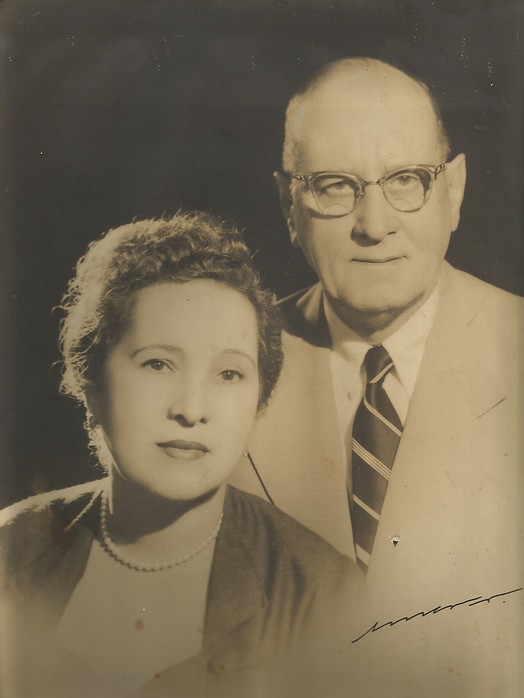
Ana Moraza and Vidal Aboitiz
But Vidal and his family, they stayed and we stayed. At that time was when they were bombing all the time at night. We had to build some kind of a shelter to get into. We would be all dressed up everyday, every night we would go to sleep and we were dressed up. And then the Japanese decided that they would take over houses and the guerillas told the Americans that there was nobody else left there except just the Japanese so they started bombing the different streets. We lucked out because our street wasn’t bombed, but the next street to us was and the other street. There were shrapnel bombs that spread out all over and killed everybody. They thought there was nobody left, but we were in our house.
One reason why we didn’t leave our house because Dad always said, “We know who our enemies are, they’re Japanese. We don’t know about the Filipinos that live there who they think we are” because we were white, they could think that we were Americans. It was very confusing. And that’s where Annie Osmeña Aboitiz and her mother, her brother, they had to go through all those mountains to get away. Eventually they were safe but they lost their father. The Japanese beheaded him because he would not cooperate with them. He was a military man and he was not going to cooperate with them. He was a hero. So it was very touchy in those days. Interesting time when you are young but for older people who know all that, it was very worrisome.
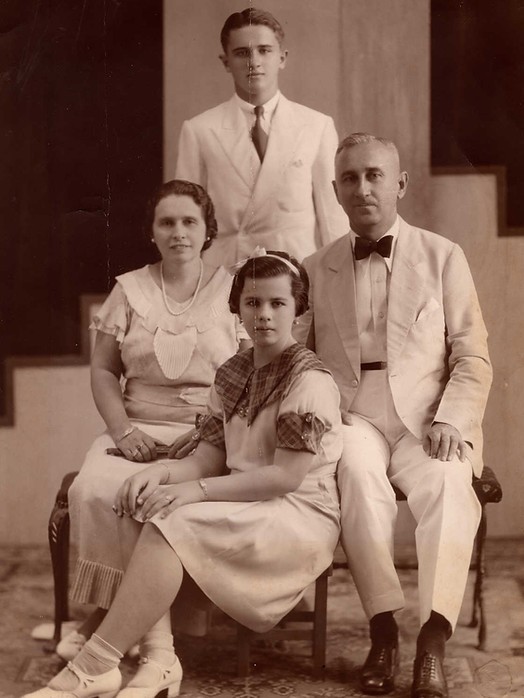
Ramon, Lolita, Eddie, and Maria Luisa Aboitiz
Eddie and my dad figured out how to keep Voice of America even if the Japanese were downstairs in our house. They had a box with a radio in it that was tied like an ordinary box was. To charge it, they had a bicycle that looked like an exercise bike and that would charge the batteries. For an antenna, they used the grills in the windows that were metal. Every night they would listen to that and if they had gotten caught, the whole family would have been beheaded. Everyone. That’s how we knew the Americans were coming.
At one time, this is really when it was all happening, the Americans were coming back and they were bombing all the airports because they told them that there were no more civilians there. They bombed all the airports and the Japanese had all the young people go to the airstrips to work on the airplanes – to be killed, that’s what would happen. Overnight there were no young people in the city and I think Nana (Lolita) almost had a heart attack because she never knew when she was going to see Eddie again because they just all disappeared. They were just gone. There were no young people in that city. They disappeared up in the mountains. They all disappeared because they were going to be told to work in the airport. All the young men were sent to work on the airfield and they were going to be killed because they were spraying and bombing all that. They were touchy times.
In our house, there were forty soldiers and one military man who was from the Kempetai, that was the most dreaded of the military. The Kempetai did all the bad things in Manila. We didn’t have too much of that in Cebu. But Eddie and my dad listened every night to what was going on. The most wonderful thing of all was to hear, as the Americans came in, those American voices saying, “Hey, guys! Come on, come on in!” - to hear those American voices in the street. They had already landed by then.
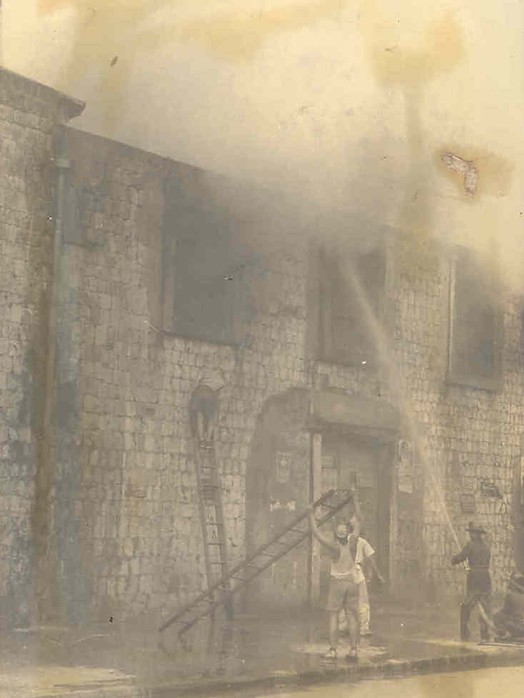
Photo by Eddie Aboitiz
At the very end, when everything was burning in Cebu, Eddie had some scotch that he was saving for after the war. He gave the Japanese captain that was in the house a lot of this scotch. They had to put a chop on the houses that were not to be burned in a map that they got. The Redemptorist was there and the Moro’s house and our neighbors’ house, the Garcias, so that’s why our house was saved. And this Japanese captain, as he left to go to the mountains, he said, “Thank you very much. I’ll see you when I get back.” “Thank you, be sure to get back.”
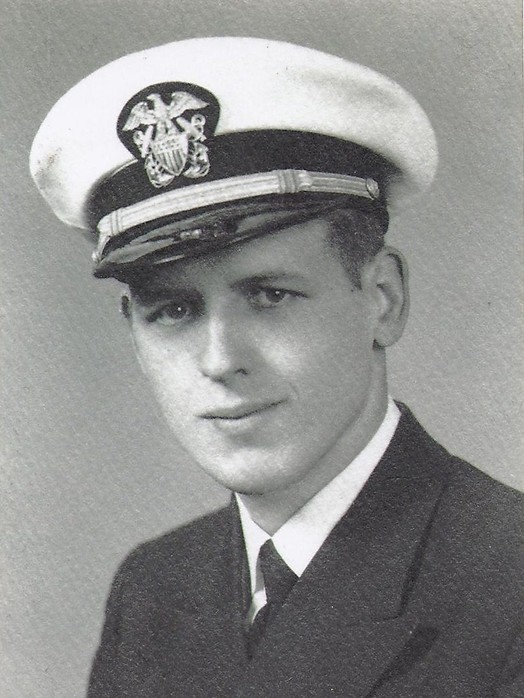
Edson Canova
The Americans landed in Leyte, then later on in Cebu. Edson, Ed, my husband, was one of those who first landed in the Navy and he was a navy patrol officer. He was actually one of the first patrol officers in Cebu. That’s what he was when they first landed in Cebu, one of the first landings. He said it was near the old Shamrock Hotel. In the ship that he came in, was Father O’Connor.
Eddie went around asking anybody that he could see that looked okay to come and join us for Easter lunch. Eddie just said, “Will you join us for Easter Sunday?” And one of them happened to be Father O’Connor who was a chaplain for Ed’s ship. That’s how it happened. When Father O’Conner went back to the ship, he told Ed, “I met this girl. She’s white and she’s got blue eyes. You’ve got to meet her. You’ve just got to meet her.” “Well, what’s her name?” “Oh, I don’t know. Maria Abortion or something. I don’t remember. It’s a different name.”
So the next chance he had, he brought Ed over to meet us. Because, in the end, you know, him being a Catholic priest, he liked meeting Catholic families. When Ed first met me, the Father said to him, “Casanova Canova.“ Ed was very good-looking. He was young, 23 years old, blonde, slim, and he was almost six feet. He was a very good-looking guy. I guess I didn’t pay too much attention to him that day. So when it came time that they had to leave, Father O’Connor said to Ed, “Casanova Canova, if I could not have done better than that at your age, I would have given up.” And then Ed said to him, “Mark my words, Father, you are going to marry us before you leave the islands.” And he did.
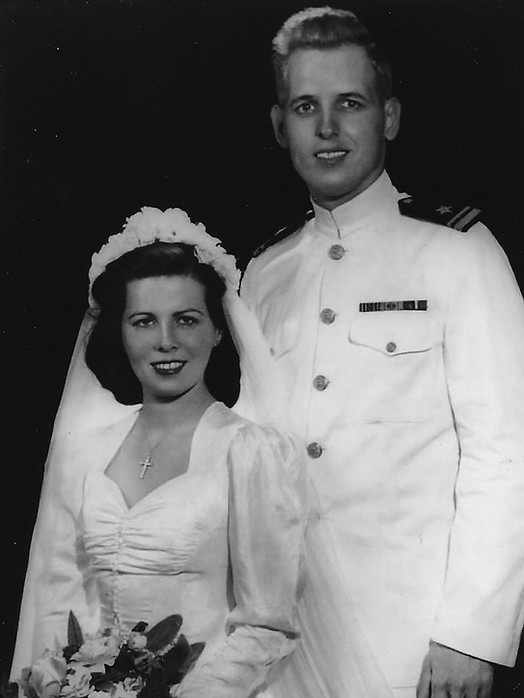
Maria Luisa Aboitiz and Edson Canova
Next time Ed and I met, I started to like him and the fourth time we met, he proposed, and I accepted and we were married for 49 years. We married and lived with his parents for a little while. First of all, Ed had to continue on. He was still in the Navy. We were married in Cebu, in the Redemptorist Church. The war was still on. All my friends said, “You are crazy, you are absolutely crazy to marry this guy, he is going to go to Japan and he is going to get killed anyway”. I said, “I am willing to take the chance”.
So, we were married and the war wasn’t over yet. We were married the sixth of August and the atomic bomb, as you know, it was dropped on the ninth. We honeymooned in Mantalongon and we had an army friend who loaned us a truck to bring us to Mantalongon and pick us up afterwards. When we slept in Mantalongon, Ed had his 45 hanging over the bed. There were Japanese around us. We didn’t know how many but there were still quite a few around us. We didn’t go around for walks. So Ed had a gun with him all the time. When our army friend came up the driveway, he kept saying, “The war is over, the war is over”.
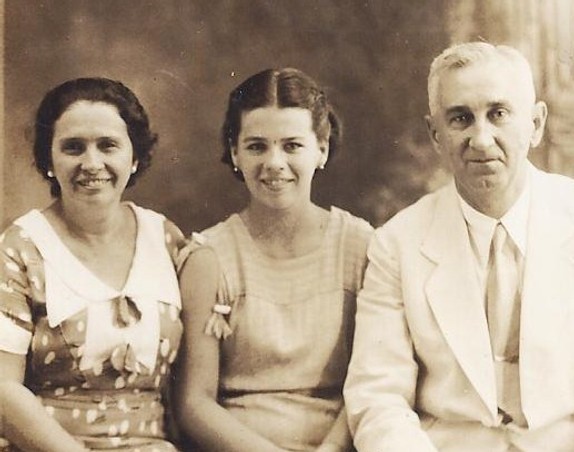
Lolita, Maria Luisa, and Ramon Aboitiz
The war was over and we just lucked out because Ed was really supposed to go on the Japan invasion. So instead, being in the navy, of course, we were together for ten days, just ten days, and he had to leave and he arranged for me to get to Manila in an army or navy ship. I had the commander’s cabin; he had arranged that. I was the only girl on board and they dropped me right in the bay in Manila. I had my little suitcases and I was ready to go. I didn’t care, I was going to the States and I was going to meet Ed and I didn’t care. I was twenty-two years old and I really didn’t care where I was going. I was young and brave at that time.
Ramon Aboitiz
2nd Generation, Ramon Aboitiz branch, from Jon Aboitiz's 2018 interview
I was born after the war, so these stories were told to me by my grandfather, Ramon Aboitiz.
First of all, they took all our ships. The USAFFE (United States Army Forces in the Far East) took all our ships but they gave us a little resibo (receipt). The interesting story that my grandfather told me was that he stored these resibos in a safe in the Cebu shipyard in Mactan. But then the Japanese took it over, so he had to retrieve those things because without them there was no evidence that the ships were taken.
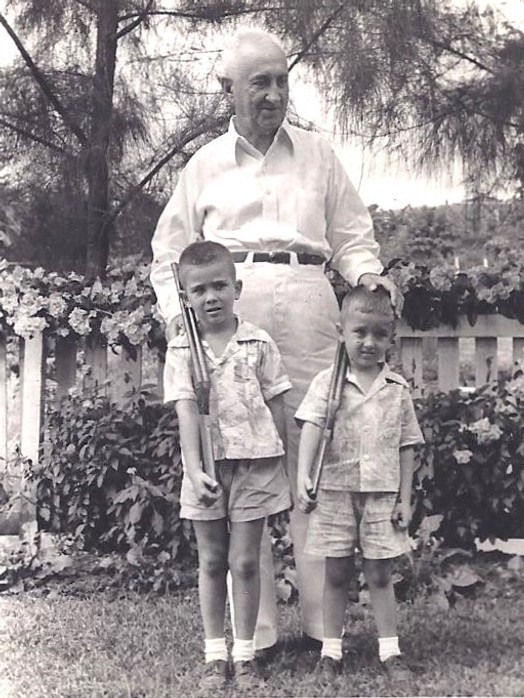
Ramon Aboitiz with grandchildren Jon and Bobby
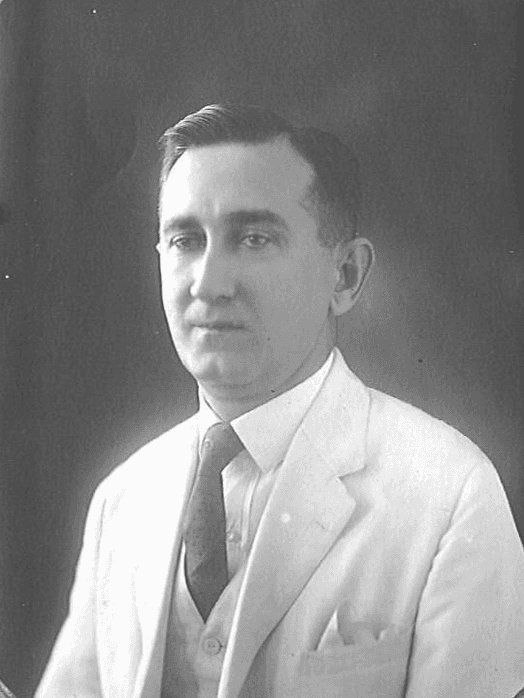
To make a long story short, with a trusted person, he was able to sneak in through the Japanese and get those resibos and come out. Then they brought them to Leyte specifically to Tio Jesus Moraza. Most of the family went out to Baybay and Ormoc to get away from Cebu. But the men had to come back to work. They had to come back to get food. They had to get whatever money they could. So, the women and the children stayed in the Ormoc and Baybay area, Hacienda Maria Teresa or whatever. The men would come back and forth and there were no steamers or stuff like that. There were these little boats, the bangkas because the Japanese sunk all the boats. In fact, I remember the story my grandfather told me about the time that he went all the way with a bangka to Manila, going from Cebu to Ormoc and then from island to island to bring some food or get some money to the family here in Manila. So the war was tough. It was tough times because everything was destroyed.
The Ugartes were in San Juan. A lot of people were in the San Juan area. So they would come here to Manila and bring some food, some money or whatever and then bring some stuff back to Cebu. I think sometime during the war some of the women came back to Cebu.
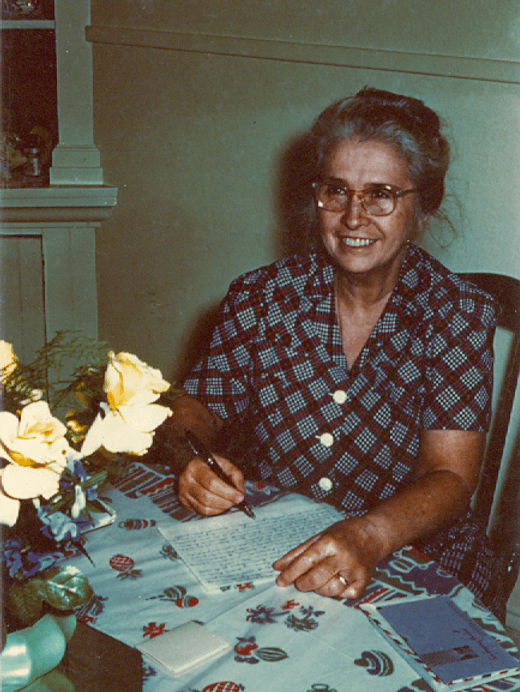
Dolores “Lolita” Sidebottom Aboitiz, Cebu, 1948
I heard a very funny story that when they came back, the Japanese kempeitai, the military police, they took over the bottom part of the house and my grandfather and grandmother were upstairs. Then one day my grandmother found out that a Japanese soldier had left his sword on top of her piano. She went berserk. She was 4 feet 11. The poor Japanese guy was running out and she was chasing him.
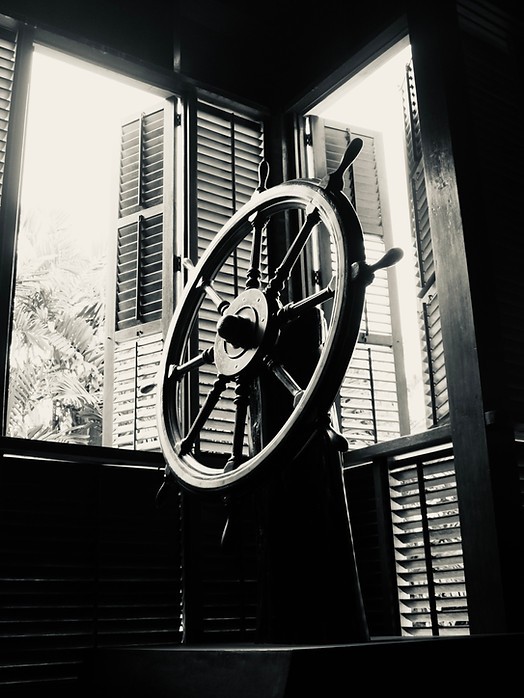
Steering wheel of the MV Tagbilaran
Right after the war, when the Japanese were kicked out of Cebu, my grandfather had gone to Mandaue for some errands and he looked at the shore and he saw one of the company’s old ships that were aground. You know how they are at low tide and it was the MV Tagbilaran. If you go to my grandfather’s house, you’ll see a big ship wheel that comes from that ship. So that was the first. It was a wooden ship. It was made here in the 30’s and it was the first ship that my grandfather was able to restore to get working after the war.
As for the others, he went to the USAFFE and he presented the resibos, and they were all valid. So that’s how the US Navy started giving back what in those days was called the FS vessels. They were small little vessels, cargo vessels about 750 tons. In the back, there was the passengers’ nook, no cabins, all on cots, and then they had two hatches. So, they were basically army ships that were used. The Americans paid us back with that and that’s what we converted as the first interisland ships after the war. They were called FS. The original ships that Aboitiz had were not returned. The Japanese or Americans sunk them all. Only the Tagbilaran is original. That was the only vessel that was saved after the war.
The FS were brought in during the war. They were American ships that were being used by the army for transporting of cargo. Keep in mind that all these cargos ships came all the way from the Marianas, all the way up from Australia and they were coming in as the Americans were going from one place to another.
So he had those IOUs. He had the evidence that he owned those ships that were taken by the USAFFE. And so, after the war, little by little, that’s how the whole inter-island business restarted with those ships. They were all the same. They were all FS. They were all partly converted to carry 200 passengers and 500 tons of cargo.
Maitena Uriarte Aboitiz
3rd Generation, Carmen Aboitiz branch, excerpt from her book, "Memorias"
*translated from Spanish to English by Maitena Aboitiz Reigeluth and Mikel Aboitiz
The Second World War had already broken out in Europe, and Augusto (my husband, son of Guillermo Aboitiz) saw it coming to the Philippines, because U.S.A. was going to have to get involved if they wanted to save Europe, and they were getting ready. Officials of the American army came to the Philippines to teach the Filipinos how to defend themselves, and some officials from the military academy came to Ormoc. They were very well educated and disciplined young men, and lots of fun.
They rented the Aboitiz house because it was big and in a central location. When Augusto would close up the office, I would meet him there and we would go upstairs to visit the soldiers and have a few beers with them. I really enjoyed their company, but my English was very bad, and I was very embarrassed to speak it. Augusto was my interpreter, but that was awkward and difficult. So I started to loosen my tongue, and began to talk. They would listen to me so carefully that it gave me courage, and I discovered that with a beer I could speak better, so each time I would make them repeat themselves, their answer was: ‘Boy, another beer.’ The ‘Boy’ was a Filipino employee who cooked for them and acted as waiter.
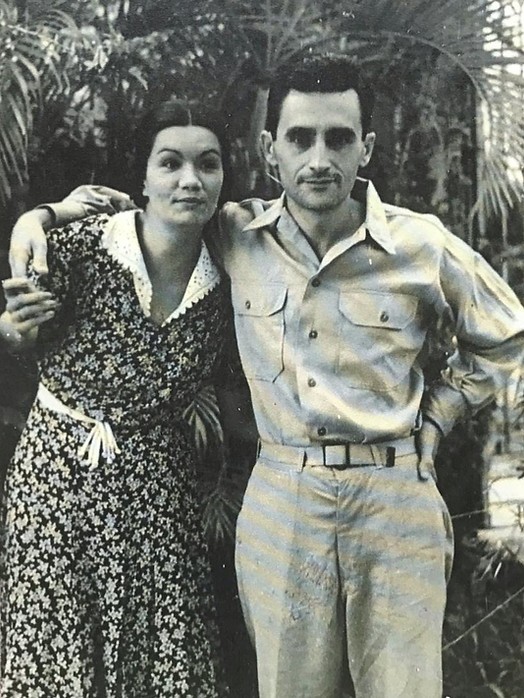
Maitena Uriarte and Augusto Aboitiz
I made them some curtains they had asked for, and used to bring them cakes. They would try to guess the name of the cake, and talked about the ones their mothers made at home. We had some very good times. This lasted a few months, until Pearl Harbor was bombed. It was such a shock to them that they couldn’t believe it. That day their faces changed. They put on their uniforms and were on watch waiting for instructions from Manila. We became very good friends, and I remember them very fondly. They all died during the war.
One of them, who was an officer in the Marines and whose name I remember as Burlock, or something like that, fell very seriously in love with a Filipino girl. I didn’t like her at all—she was disagreeable, and ugly as well. He told Augusto that his troop was going to surrender. Those were the orders they had received, and it was useless to fight because they were not prepared. But he was planning to run away, and gave his girl thousands of dollars for her to buy food supplies and look for a place to hide in the mountains until the war ended. Augusto and I found this outrageous, and immediately thought that the woman was going to disappear with his money. But we couldn’t say anything, and even if we had, he would not have believed us.
We gave him a farewell dinner, which he had asked for, and I came to dislike the girl even more. She told us that she had a daughter with a German guy, but she had left the child with her mother to take care of. We couldn’t comprehend that our friend would want to escape with that girl, and it became a terrible secret that we kept till the end of the war. The Japanese arrived in the Philippines, and MacArthur managed to escape to Australia in a submarine. It was then that he said his famous phrase ‘I shall return’.
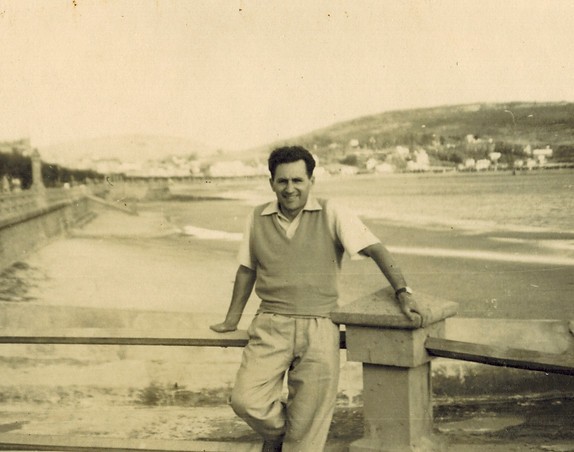
Augusto in his twenties
The Japanese appeared in Ormoc, and they looked for Augusto to force him to start up the electrical plant. Augusto had hidden some fuel barrels and some other important pieces so that the Japanese would not be able to start up the plant, but these people did not fool around and told him that he either started it or they would cut his head off. And they would have done it without batting an eye, so Augusto unburied the barrels and put back the parts and restarted the plant. He had also buried, in a tightly sealed tube that he made especially, some of our jewelry and valuable things, and that was a good idea because we found it when the war was over.
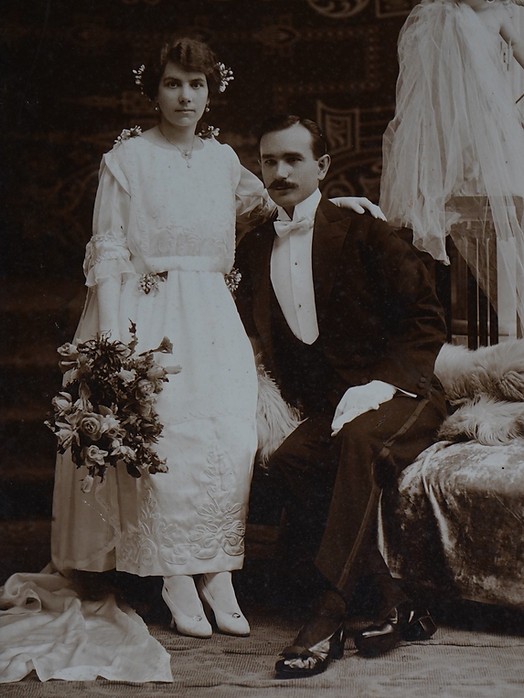
Carmen Aboitiz and Teodoro de Uriarte
Because of his ulcer, my Aita (father) was sick a lot. Every so often he had to overeat with a lot of milk, and he needed rest. He couldn’t go horseback riding or do things that required much effort. As a consequence of all this, he would get anemia, which would leave him very weak. The cure was to go to stay for a while at a clinic in Baguio, and he would come back like new. He would stay there for a month or so, and then return.
The arrival of the Japanese caught my Aita in Baguio, and he had to stay isolated there. Since Augusto and I were in Ormoc and my stepmother was alone in Hacienda Maitena, which my Aita owned. I told Augusto that we should go keep her company, since it was so risky for her to be alone there. So we settled into the hacienda, but instead of viewing it as us doing her a favor, she took it as if we wanted to take over the place that belonged to her and her husband. She treated Augusto very poorly, and he was the first one to see that she had mental problems. After some time we got tired of her and returned to Ormoc, but one day she came crying, pleading for us to return, saying she was very lonely and in great danger. So Augusto returned to take charge of the hacienda until Aita was able to return. Then she went to my Aita telling him that Augusto wanted to take over the hacienda, but my Aita didn’t believe her much.
My Aita went through a lot of trouble to leave Baguio. It was very difficult to find a boat with a motor and the crew to take him to Ormoc. Since it was a small boat, the trip took 17 days, and my Aita was very frightened, because during the trip he learnt that they were criminals and were armed. He used to say that the Japanese had truly ‘made the East greater’ (as they would say in their propaganda), since it had only taken him a few hours to get to Manila and 17 days to return.
While living in the hacienda, Augusto told the Japanese that he needed a car to run the plant, and they let him. The Japanese had confiscated all the cars, refrigerators, and everything else they wanted. None of them knew how to drive, and it was sad to see beautiful cars abandoned in ditches or wrapped around some post. They put an authorization sticker on the car, and a Chinese friend translated it for us. It said ‘This car belongs to the Emperor Hirohito’.
One day the fuel for the electrical plant ran out, and they told Augusto to find more. Augusto told them that maybe he could find some in Cebu, so they gave him a travel pass and he was able to go to Cebu by himself. He found the fuel and was able to load it onto a Japanese boat that was going to Leyte. And that’s how we lived under the Japanese for about a year. The Americans were placed in the Tacloban jail, and one day we found out that they were going to decapitate our friend Burlock. They asked Augusto and the Mayor of Ormoc and a few others to be present at the execution. Augusto refused, and thank God they didn’t force him. They said that there had been a blackout in the jail and that Burlock had tried to escape, and it looked like he had organized the blackout. Nobody believed that story because blackouts were very common, especially during the Japanese occupation. But poor Burlock was killed with an ax. How sad we felt!
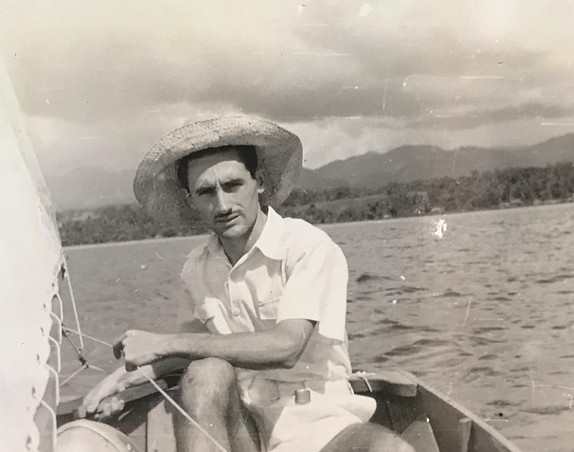
Augusto, Philippines, circa late 1930’s
After some time, the plant ran out of fuel once again, and once again Augusto asked for permission to go to Cebu. But this time he told me: ‘Fill up the suitcases with whatever you think is important, because we’re leaving for Cebu.’ We got on a boat, Aitor (my oldest son), Augusto and I, with my suitcases and a few sacks of rice. We did it at night, as discreetly as possible, and were in Cebu in the morning. We went in a tartanilla (small horse carriage) to Tío Ramón’s house. Many people had left Cebu, escaping the war and the Japanese, leaving their houses empty. They told us to occupy one of them, and that their owners would thank us, so that’s what we did. The house was in good shape, but completely empty, so we went to the Irish convent to see if we could find some furniture. Many people had left furniture in their care. This way we found beds, some chairs and a table, the basic things to live, and we built our home for the war.
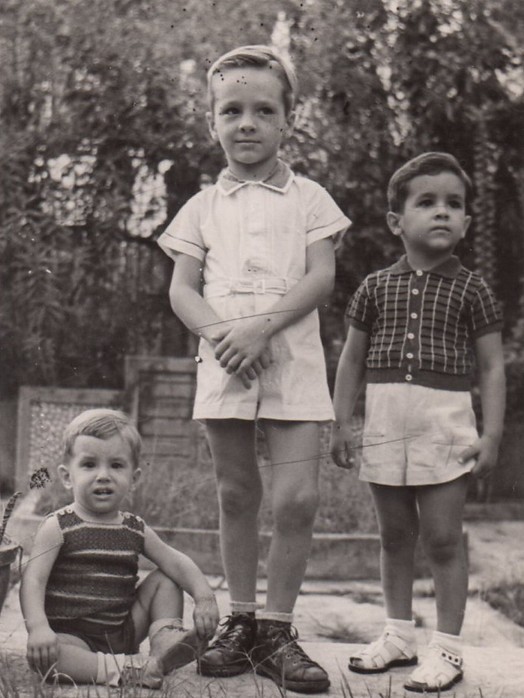
Txomin, Aitor, and Iñaki Aboitiz, Cebu, 1946
The nun’s school was across the street. I became pregnant with our second child, and I didn’t have any help. I didn’t even have a refrigerator, only a stove that ran on wood or charcoal. Of course, we didn’t have a washing machine. I was able to find a washwoman, thank God, but I still had to go to the market, cook, clean the house, and so forth. We didn’t have a car or a bicycle either. Aitor was having a great time, going from yard to yard, under all the neighbors’ care, so I asked the nuns if I could send him to the school in the mornings. He was just two years old and only needed to cross the street, where every once in awhile a Japanese car would drive by. They agreed to have him, but only if he knew how to go to the bathroom by himself. I was very proud to tell them yes, he didn’t use diapers any more. His cousin, Donny Moraza, two and a half years older than him, also went to school there. The two of them would go holding hands. Every once in a while at mid morning Aitor would appear at home, when he was bothering them in class I suppose. The poor child learned to go up and down the service stairs that were quite steep. He could barely hold on to the banister with his little hands, but he never fell.
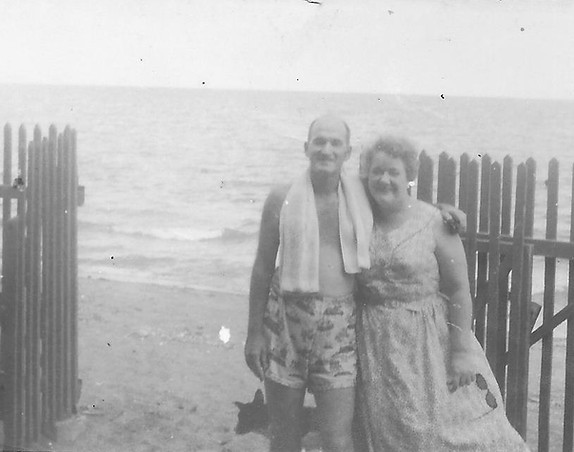
Joe Moraza and Rose McNearney
Across our yard there was a two-story house where our cousins Joe and Rose Moraza lived. They were hosts to a Swiss company with their Swiss employees, and their boss kept an eye on Aitor and would bring him down from a tree or a broken down car that was in the yard. His name was Mr. Gilbert. Years later I learned that he was a millionaire. So I can boast that my son Aitor had as a yaya a Swiss millionaire.
Some of our friends or cousins would also take Aitor by the hand, and he would go off with anybody. Everybody loved him. One day, the Japanese closed the school and turned it into a boarding house for some special troops. We could see them doing exercises and other things, but they didn’t look dangerous. Aitor learned the Japanese national anthem, and he would sing it all the time. The Japanese must have thought he was very cute, and very often he would appear holding hands with one of them saying: ‘My friend, my friend.’ And, of course, I had to receive him well, but I was actually very scared.
Finally I found a maid to help me with the house chores, and I started to adjust myself to our new life. It came time to give birth, and luckily my doctor was able to assist me in the civil hospital managed by the Japanese. The childbirth was very good, and on December 17, 1942, our second child, Iñaki, was born. I already had baby clothes and diapers handed down from Aitor. I remember we were able to buy a crib that cost us two bottles of rum. We bought things that way, trading one thing for another, except at the market, where we had to pay with a Japanese currency that wasn’t the yen or the Philippine peso. These currencies were out of the official circulation, and were only used in the black market. When the war started, Augusto took the precaution of buying canned food and powdered milk for the kids. The cans were left over from when we were able to buy American products. Powdered milk became so expensive that we could live for a month by selling just one large can. Sulfathiazole pills also reached astronomical prices, because it was the new medicine that cured everything. It came to be the currency of the market, and a common question was ‘What’s the price of sulfa today?’
During the war we all had our little vegetable gardens, where we planted everything we could. Most of our produce came from the garden, except for sweet potatoes, which were easy to buy. We could also buy fruit, and we had coconuts, as much as we wanted. We used coconut for everything, and the truth is that they kept us alive during the war. There was a Spanish woman who would say that after the war she didn’t want to see another coconut for the rest of her life, and someone else would answer: ‘Well, you should thank the coconuts, because thanks to them we’re alive’. We ate several coconuts a day. We used the outside as a dessert, grated, and the rest we used to make milk. We would throw the shredded coconut in water and squeeze it with our hands until it was fairly dry. We used that milk for everything. It was a bit heavy for drinking—you couldn’t drink it as milk. We bought our milk from somebody who had a caribou. That milk was very strong, it wasn’t easy to drink either. It was very thick and had a strong flavor. The milk we liked was the powdered kind. Powdered milk and condensed milk were treasures, so we had to strictly measure whatever we used. But coconut milk could be used at any time, and what was left of the coconut, already dried, was given to the chickens.
We all had chickens. They were easy to keep, and they always gave you eggs, one or two a day, which was all we ever needed. We never lacked eggs. You could also buy chicken and fish. We ate a lot of rice and also a lot of corn that could be ground the size of rice and cooked the same way, with a bit more water. It was very nutritious.
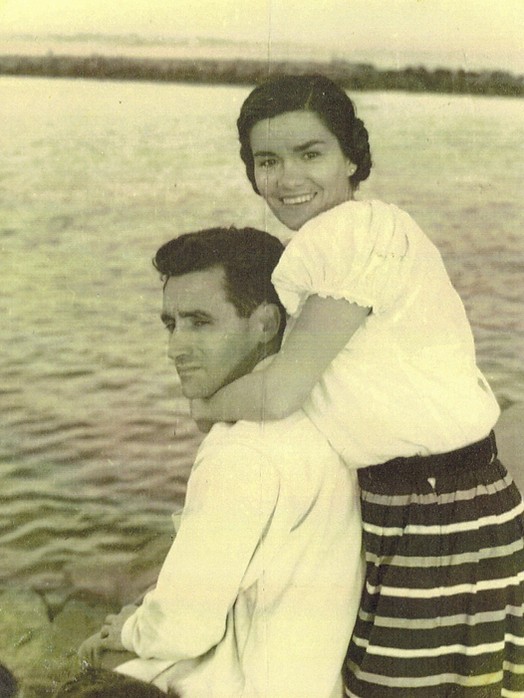
Augusto and Maitena, Uruguay, 1949
Augusto used to go to the port area with Luis Rotaeche to try to find some kind of boat. Luis wanted to go to Manila with his family, and Augusto wanted to go to Ormoc to bring things from our house there and some tools from the Aboitiz office. One day he was able to find one. It was a motorboat that apparently didn’t have permission from the Japanese to navigate. So he hired one member of the crew and went alone with him. He had been thinking of returning in a week or so, but several weeks went by and Augusto hadn’t returned. You can imagine how scared I was! But one day he appeared with I don’t remember how many sacks of rice… and my sewing machine! He told me all about his return journey, which was very risky. They were caught in bad weather, and even though they sailed close to the shore, they couldn’t take refuge in any inlet for fear of the guerrillas. Not only would they have lost all their possessions, but on top of it, Augusto would probably have been kidnapped. And so they sailed, with all that against them, for days and days until they got to the coast of Cebu. They proved to be good sailors and Augusto was saved.
So he appeared at our house merrily, with all the tools he could carry, the rice that was so valuable, and my sewing machine, may God be praised. I was able to make shirts for Aitor and Iñaki with some white sheets, and I made new pants for Augusto with leftovers of his pants that I had made into shorts. I was also able to mend the clothes that tore or needed repair. It was my salvation to recover that machine.
And so two years went by. One day I started to feel sick, with nausea and vomiting, and my doctor, who was good for everything, told me I was pregnant. He felt my belly and by touch he said I could be around three months along, meaning the birth could be in September or so. You can imagine how scared I was, but what could we do? Full steam ahead! Luckily he told me that I was healthy and in good shape, and I was young. Also by luck I was able to bring back the girls that we had hired in Ormoc. When the war started they had gone to their homes to be with their family, as was of course natural, but I had been left without help for an entire year. So I saw the skies opening up.
The Japanese kicked us out of our home because they needed it for themselves. Fortunately, we found another empty house, a bit smaller, and with a tiny yard. It was close to the other one, so we were able to make the move on our shoulders with the help of all the cousins and friends.
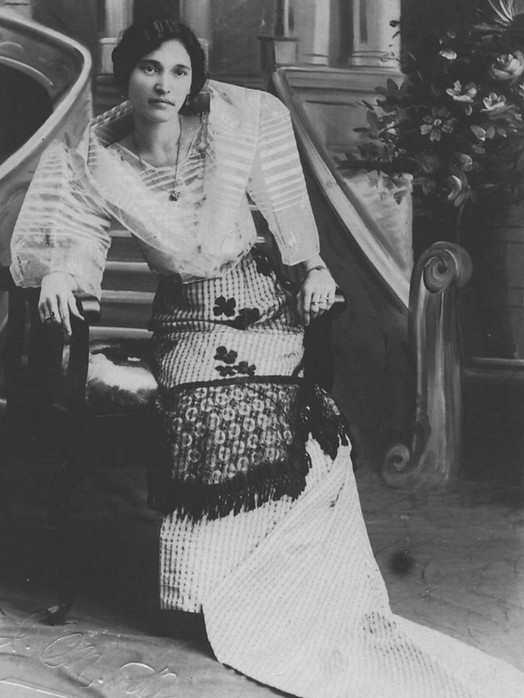
Martina Arizaleta Moraza
The men decided it was necessary to build a shelter in the backyard, to take refuge when the bombing started. In the garden of Tía Martina, who lived with her son Isidro and his wife Antonia, there was a concrete hut that had been built by the English Bank to keep their documents safe. It was a very strong structure, and they decided to build the shelter under it, in an “L” shape. Between all the young men they dug a ditch about two meters deep and the width of about one person, with steps for the entrance. You could fit in about 10 people in a row. There also was a bench where we could sit down, one right next to the other. It was a very safe shelter.
The house also had a roofed veranda, furnished with wicker sofas and tables, where we would get together almost every afternoon. We would play mahjong, and the children would run around and have fun. When the bombings started, we would all get into the shelter. Since I was pregnant, they always wanted me to enter first, because I was the slowest one. But that really bothered me, so after much complaining I was able to be the last one in.
The bombings didn’t last very long, and we felt safe. A bomb would have to fall right on top of us to do us any damage. Augusto had to dig a trench all by himself, to fit the whole family plus the two maids, a total of 4 adults and 2 children. Then he added a zinc roof, which he covered with dirt, the same dirt he had dug out from the trench. If anybody was planning to visit us, we would warn them that our shelter was very small, so we didn’t usually have visits. We would mostly get together in the bottom floor of Tía Martina’s house. We could just walk over there. When the planes were small we were not scared, since the bombs always fell on the desired objectives. But when the big planes came and it was nighttime, then we were scared, and we would go to the shelter as quickly as possible.
The men would go every afternoon to an abandoned house where they kept a radio. They had it connected to a bicycle and one of them would pedal to charge the battery. This way they could hear the BBC and find out about the real news. One of them would put on the ear phones and listen, another one would receive the dictation and write it down, and the other two would watch to make sure there was nobody else around, much less a Japanese, in which case they would all run out of there. That’s how we found out what was happening with the war
My pregnancy continued, and the doctor told me that if the delivery happened at night, he would not be able to come, since his house was far away. We really got scared then, because there was a large probability that I would end up giving birth by myself. Augusto found a manual on how to give birth without a doctor, and the two of us were trying to memorize the instructions to be ready. Very close to us lived a Spanish family whose son was studying medicine, but he didn’t have any experience yet. I asked him if he would come help us, and he said yes, as long as it wasn’t at night. Antonia, Tía Martina’s daughter in law, offered to take care of me, but since she had two small children, it was going to be a lot easier for her if I gave birth in her house. And that’s how we decided to do it.
Several times I had signs of labor, so very often I was packing my bags, but they turned out to be false alarms. My date was very approximate, since I had become pregnant without ever having my period. This uncertainty, added to my own nervous impatience, were the cause of these false alarms. But finally the day arrived. We were in full-fledged bombing, but at least it was daytime. I went to Antonia’s house and called the medical student. His family called him “Bartolín” and, since he was so young, we also called him by that name. The word spread among the family, and there we were, surrounded by our relatives, because everybody wanted to be present for the birth. Bartolín also came, with a male nurse that he found. This person did seem to have some experience.
They put me down across the bed, and I gave birth very well, without any complications, to a beautiful baby boy with red cheeks who reminded me of the Basque stories we were told as children, whose protagonist was always called Txomin. Augusto and I had thought of calling him Mikel if it was a boy, but when I told him that he reminded me of Txomin, he said: ‘Then Txomin it is.’
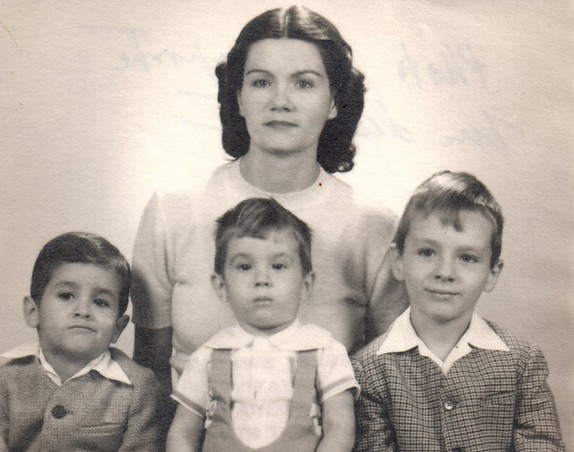
Maitena with Iñaki, Txomin, and Aitor Aboitiz, 1948
We named him Txomin Mikel, and he was born October 7, 1944. He was our third boy, and we heard people in the next room say with disillusion: ‘Another boy!’ When I had him in my arms, I felt sorry for him and I told him: ‘Nobody loves you, but I certainly will’. The mosquito netting on the window had a hole in it, so the next day when Aitor and Iñaki came to meet their new baby brother, we told them: ‘Look what a pretty baby the stork brought us. See that broken window? Well, that’s where the stork came in.’ I was lucky that during the delivery we were not bombed, not even at night. But afterwards, every time I bathed the baby and had him all soapy and wet, no matter the hour, the bombing would start without fail. I would wrap him up in his towel and run off to the shelter. At least in the Philippines it’s never cold. Antonia took very good care of me, and when I felt strong enough I went home with my baby.
That battle between the Americans and the Japanese was one of the biggest naval battles in history, but we were happy to hear the bombs, because it meant the end of the war. The night bombings increased, and I was already training Txomin to sleep 6 hours straight. I had to wake him up to go to the shelter, and on our return there was no way to make him fall asleep again. Luckily, I had a lot of milk and was able to nurse him without any problems.
When my Txomin was around three months old, the men started to come with horrific stories about the Battle of Manila. The Japanese would not surrender, and since they knew they were going to die, they started to kill willy-nilly, raping women and burning homes. They would start fires, and when the inhabitants of the house came rushing out, they would kill them. We thought the same thing would happen in Cebu. Tío Ramon’s house had been requisitioned by the kempeitai, which was the military police of the Japanese army. They installed themselves in the ground floor and allowed Tío Ramon and Tía Lolita to live upstairs. It was then a very dangerous place to be during the American bombings, but the curious thing is that it was never bombed. Tío Ramón decided not to leave the house because he was afraid that the Japanese would kill them if they did
Our friend, Varín Pastor, who still believed in Franco and because of that he would negotiate with the Japanese. He and Augusto decided that we needed to escape, fearing we would suffer the same fate as in Manila. This man had contacts with Cebu’s mayor and was able to get the mayor’s driver to take us to a beach called Talisay, some 15 kilometers outside the city. Varín had hired two barotos, small rowing boats with sails, which would take us from Talisay to Bohol, an island that was about two hours away from Cebu. But we needed to leave the beach before sunrise, which was when they started bombing the beaches if there were any boats.
And so we left one dark night, like a band of criminals, with some suitcases and sacks of rice, my baby in arms, escaping from the Japanese. We went along the only road to Talisay beach, but on the way every so often there was a Japanese guard who would stop all the vehicles that went by. The first one, half asleep, recognized the mayor’s truck and let us through. It was a dark night and you could hardly see. The second one made a gesture as if he was going to stop us, but we slowed down a bit and he let us through. Varín had offered the driver, besides a lot of money, I don’t know how many sacks of rice and cigarettes each time we passed a guard safely, so we hardly stopped. But that one must have notified the guard ahead, because this time he stood in the middle of the road to make us stop. I was scared to death, because if they caught us fleeing, they would surely detain us. Varín got off and offered the guard a cigarette and Augusto showed him a paper that the Japanese had given him when he was bringing fuel to Ormoc that time. He had kept the paper. The guard saw the mayor’s truck and it was so dark that he could hardly see what the paper said, but I guess he just saw the Japanese seals and that was good enough. Txomin didn’t cry and we were all trembling. We took a deep breath and continued to the beach, but it was already dawn
The boats were already waiting for us. There were two, one per family, and when we were already at sea we saw the first plane. Varín and Augusto told us: ‘Get up and wave your handkerchiefs, so they will see we are friends and won’t shoot.’ That worked. We released the sail and arrived at the other island about three hours later. On that island there were no Americans or Japanese—it was barely inhabited.
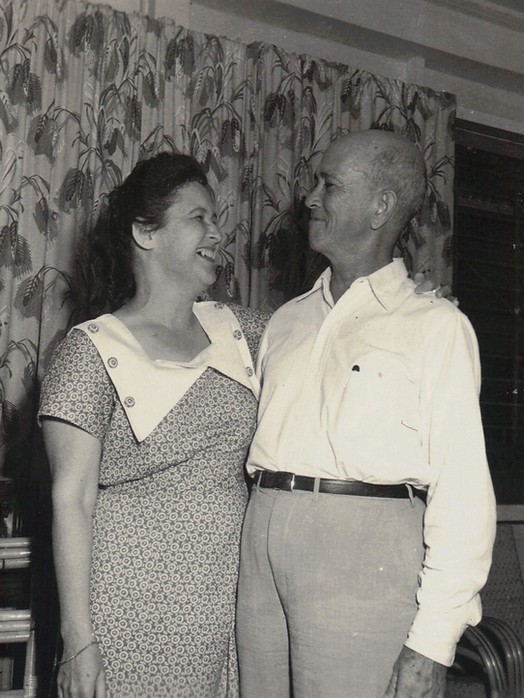
Elena Miciano and Fernando Moraza, Cebu, 1951
We got inside a beach hut for a few days, until the men found a bigger boat, with a motor and sails, that carried merchandise from one island to another. In Bohol we found Tío Fernando and Tía Elena with their children, who like us wanted to go to Leyte. And so our two families set off for Baybay, a city in Leyte, where the Americans were. The trip took us three days. We had enough water and food but the bathroom was just a chair with a hole in it and a bucket underneath, with a family member holding a towel or something as a curtain. It was impossible for me to go, the embarrassment was too great. So when the captain decided to stop for a while near a coast, Augusto suggested we swim to the coast to find a tree for me. With my aunt and uncle completely astonished, we went into the water with our clothes on and arrived at the shore, but no tree was good enough for me. We decided to return to the boat again, and my aunt and uncle could breathe again.
When we were about to reach Baybay, a gust of wind kicked up and broke the main mast. There we stood, waiting for the repairs, until they offered to land us in a rowboat that could take us to the beach. Our clothes were already dry and we got off. We took to the road and went towards the town. We saw the first Jeep with American soldiers, who stopped when they saw us, but since we were so many, they told us to wait for the truck that was coming behind.
On the way we saw a woman walking with a loaf of American bread under her arm. The emotion and temptation were so great that we approached her to buy a piece. She told us that up ahead there was bread for sale, but we couldn’t wait, and so, without her offering, we grabbed a piece from her arms! Remembering it now fills me with shame, but the woman seemed to understand and didn’t get mad. Several Jeeps went by but they kept saying that we didn’t all fit. So we asked them if they could at least take the children with some women, so they did. We arrived at the Moraza’s home, which was very big, and found other family members that had already arrived.
We couldn’t all fit, so we looked for something to rent and found a nipa hut made out of leaves and wood, built on some wooden stilts. It was all sand beneath the house, and the sea was right there, although we couldn’t actually see it from the house. The floor was made of beautiful wooden boards that had a spectacular shine to them. The kitchen was typical Filipino style, with the sink sticking out a window. It didn’t have running water, but it did have electricity. The bathroom was outside the house, and you got there by crossing a little bridge. It consisted of a little hut made out of leaves and wood, and the floor was made of bamboo, in such a way that the water just ran through the spaces between the reeds. Every day a boy would come and fill a big barrel with water. The toilet was the typical wooden seat with a hole and a lid. That bathroom, for some reason, was always full of spiders of all sizes, and I observed that they were harmless. They only ate mosquitoes and flies.
We also discovered that the house had bed bugs. I had never seen bed bugs in my life, but at night we were bitten by something that wasn’t mosquitoes, because we slept under mosquito netting, and when we turned on the light, we couldn’t find anything inside the netting. Finally we decided to look under the mattress, and there they were. It’s an insect similar to a tick that hides during the day and only bites at night. We started to clean beds, floors, furniture and everything I could think of. First we used boiling water with soap, and then tried with gasoline. I don’t know how I didn’t burn the house down. Then somebody told me that if I took the beds to the beach and submerged them in the water, they would die. So one day between all of us we submerged the mattresses for an hour or so, but that didn’t work either. I think it improved a little, but it was such a pain to do it that way. We had become friends with the Americans right away, and some of them came to spend a weekend at our house. One of them, an official of the CIC, sent us two little cans with DDT powder, with a little card that said: ‘Good scratching’. I didn’t know what DDT was, but I spread it on all the beds and especially in the baby’s crib, and what was left over I spread on the gaps on the floor. That really worked, and it was the end of the bed bugs.
The children caught the measles, and I decided that the baby shouldn’t catch it. So before picking him up not only did I wash my hands and face but I also put on a white robe over everything, that I would only use when I got close to him. The whole family stayed away from us for 40 days, so as not to spread it to their children. The quarantine seemed to last forever, but my Txomin wasn’t spared. He also caught it, and we had another 40 days of isolation. How boring!
We told the story of our friend Burlock to Scottie, the official from the CIC, and I told him how I didn’t like that girlfriend of his, since she had had a child with a German which she didn’t even take care of, and during the war I heard she had taken up with a Japanese general. The Americans needed proof, since now she was the lover of an American captain. This was the last I heard about that girl, but I became convinced that my feelings toward her were well founded.
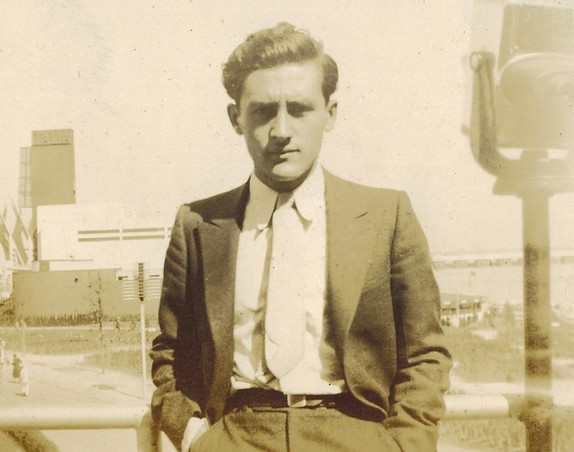
Augusto, 1933
Years later we visited Scottie in Rehoboth, U.S.A., and he told us that in Baybay he had found Augusto’s name in a blacklist of the American army. For a long time there were guerrilla fighters that fought for Philippine independence, and they shared information with the Americans. It turned out that they had Augusto as a collaborator with the Japanese, because he had started the electrical plant. Scottie saw Augusto in the black list provided by the guerrillas, with a double X, which meant ‘shoot on sight’. He immediately crossed him off that list, because he knew that it must have been a mistake. We found the story very amusing
One day an American official, who spoke Spanish very well because he was of Mexican origin, came to visit. He had become our friend. He arrived at our house very pale and with a shocked face because he had just learned that the United States had dropped a bomb on Japan that was called ‘Atomic’ and was terribly destructive. It was so powerful that for 70 years nothing would be able to grow in the land touched by the bomb, and those who were contaminated would not survive. We were also told that the problem they were having was that the Japanese refused to surrender, because surrendering was such a dishonor for them and their descendants. Even though the war was already over and they had to negotiate peace, the Japanese mentality made it impossible. The Americans would have to land in Japan and fight door to door, and a lot of Americans would die like bed bugs. That’s what had happened in Manila, and also in Cebu. There were no Japanese prisoners, because they would never surrender. Finally, the Emperor Hirohito decided to give in.
They said that the Emperor had been trying to surrender for some time, but the generals wouldn’t allow him. They told us that on one occasion they found a Japanese soldier on the road, completely naked and holding up his hands as to surrender, but when they got close to him he threw a grenade he was holding, killing himself as well. About 20 years later a Japanese who had been hiding in Mindanao, I think it was, came out and wanted to surrender. He hadn’t heard about the end of the war. It was in all the papers. Of course nobody punished him, and they returned him to his family in Japan. The first thing he did upon his return was go to a shrine and ask forgiveness for being alive and having surrendered.
One of the punishments they gave Japan after the war was the prohibition to arm themselves or have an army. In my humble opinion, this was one of the reasons why their economy grew so rapidly, since they saved the costs of having an army. Don’t you think?
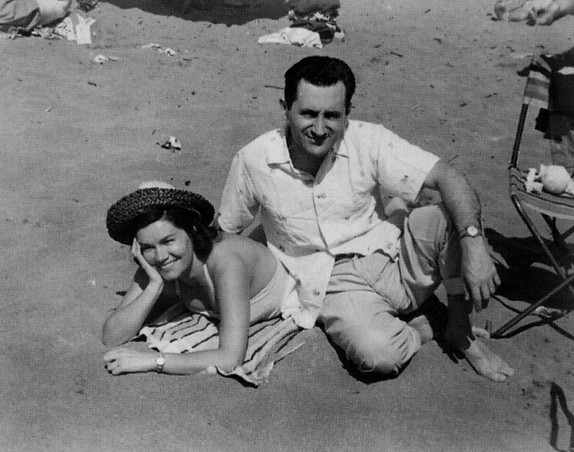
Maitena and Augusto, 1953
While we were in Baybay, the American army was starting to leave, and they didn’t bother to take with them their jeeps or their sunken ships. Augusto and his cousin Joe Moraza saw a sunken boat near the coast and thought that they could salvage it and make a good profit. They asked some navy officer if they could refloat and use it. They were given permission and started working on it right away. After refloating, cleaning, fixing the motor, etc., they decided to start taking passengers from Baybay to Ormoc. They charged as much as a bus ticket, and it filled up with people every day. It was a good business until an army captain saw them and thought: ‘These guys don’t have permission to do this’. He mentioned this to an American friend of Augusto, telling him he was planning on confiscating the ship. But this friend told Augusto that he could stand by the dock and warn him when the captain was there. So they would stay in the water until they received word that the coast was clear. It was a good business, while it lasted. Finally we left, and so did Joe, but they were able to sell the boat with all the documentation. In truth they were acting correctly and that American captain didn’t have the right to confiscate it—he was acting out of pure envy.
Bill Paradies
3rd Generation, Vidal Aboitiz branch, from Bobby Paradies' 2019 interview
My father (Bill Paradies) had a radio. It really scared my mother (Carmen Aboitiz). He would disassemble it and once it was lights out, he would reassemble it. They would listen to the illegal radio and it was not allowed to hear the news about the war. My dad told me he would take me up on the roof and rock me at night while I was crying from colic, and the planes would fly above.
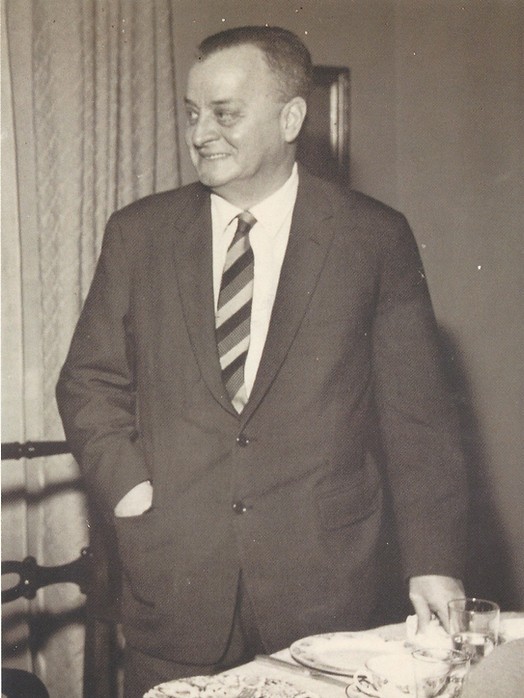
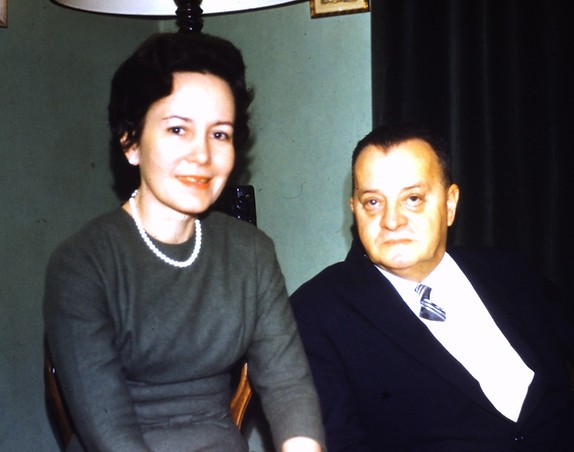
Carmen Aboitiz and Bill Paradies
He decided it would be best if we evacuated from Cebu. He had been collecting cases of liquor. They had to drive through checkpoints and he would give these to the Japanese as bribes to allow them to pass. He put us on the boat (he didn’t go with us) with other family members and sent us to Leyte. My mother remembers how they had to avoid all the mines as they went through the water to get to Leyte where they stayed with the Escaños. My father was related to them through my father, on the Fortich side. I was maybe a month old.
Louie Aboitiz
3rd Generation, Luis Aboitiz branch, from his 2019 interview
When the war started, I was eleven years old and when it ended, I was fourteen and a half.
I don’t remember it but I’ve been told, that Tio Ramon had just sold the sardine factory, which he started in Moro with some Basque fishermen, to the government. He was not convinced about the Japanese losing fast, and the Philippine government wanted to get rid of the Basques and give the livelihood to the local fishermen. He had a lot of money and he didn’t put it in the bank. He withdrew all the money he could from the banks and put it in a safe. Other people were not that worried, but Tio Ramon was. That’s how we were able to survive the World War, the Occupation, without having to cooperate with the Japanese by being in business with them because if he had kept the money in the banks that money coming out would be Mickey Mouse money, Japanese money.
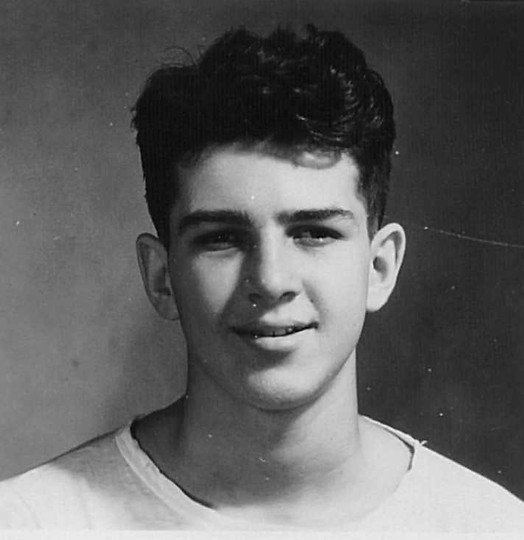
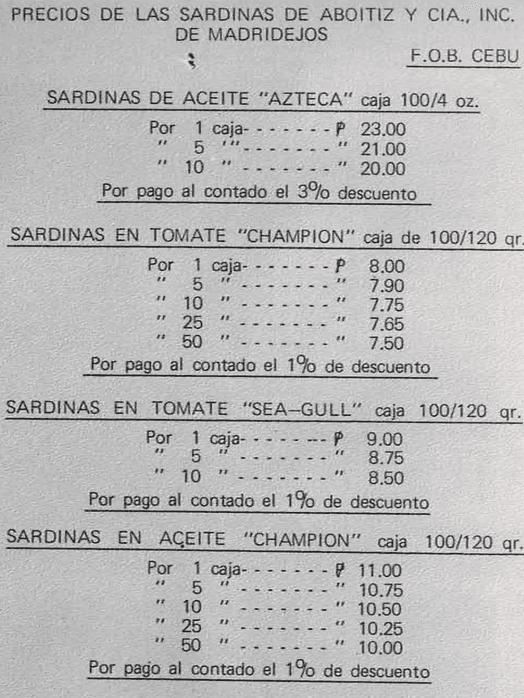
When the Japanese started to invade Cebu, the Americans all went up to the hills beyond Busay. That’s where they had their main storage, bodegas of food, ammunition and everything. And then, when the Japanese attacked Cebu, they said they couldn’t stop them because they had no anti-aircraft guns, they had only a couple of machine guns. They were completely unarmed.
The Americans opened the bodegas to the hill folk and it wasn’t looted, it was just taken by the hill folk, all of them. But the hill folk didn’t like a lot of the food, so they would bring it to Cebu to sell, piece by piece. That’s how we were able to buy a lot of canned goods, corned beef, Spam, a lot of things. Tio Ramon, how smart he was, bought a lot of cigarettes in cans even if he didn’t smoke. And I asked him, “Why did you buy this?” He answered, “To people who smoke, this is money.” So clever. So fantastic and clever. That’s how we were pretty well fed and well financed because Tio Ramon would give it to everybody in the family, including family in Manila.
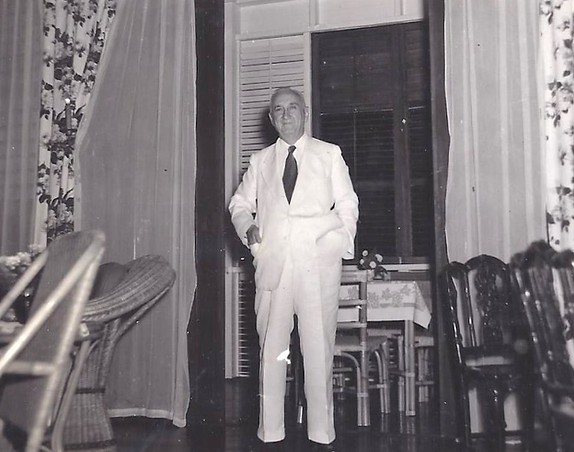
The family couldn’t move in with Tio Ramon because the Japanese kempeitai, military police, took over his house. Out of respect, they only took the ground floor. They never invaded the top of his house. We lived in a house in which is now the Asilo. We lived there throughout the whole war except a couple of times we evacuated... that was the “bakwit”... first to Baybay and then to Ormoc. We had to move because we were afraid of the Japanese bombing. They couldn’t stop it since they had no anti-aircraft weapons. We’re so lucky that the Japanese didn’t have very good aim.
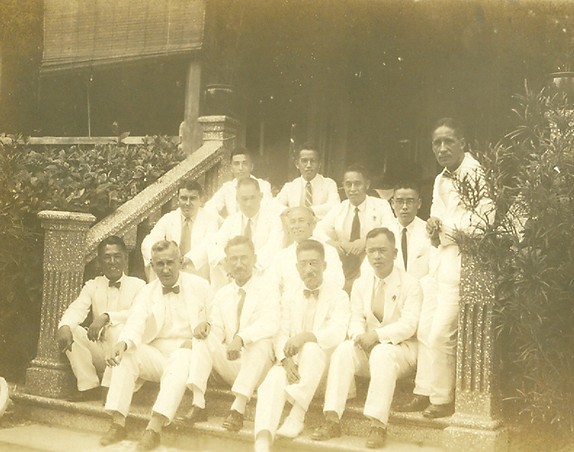
Mr. Otsuka furthest left on the first step seated beside Ramon Aboitiz. Luis Aboitiz behind, 1931
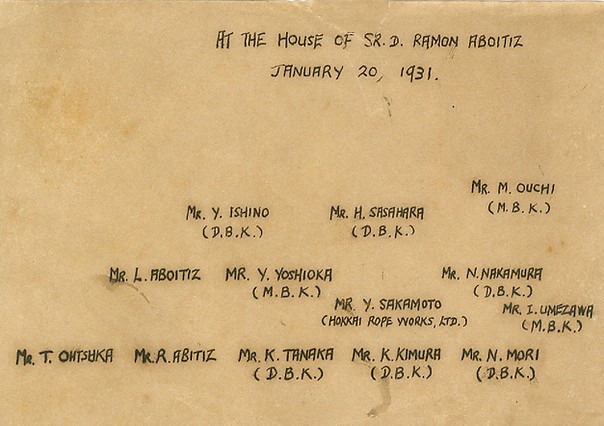
When they first invaded Cebu, we had an employee partner called Otsuka in the abaca trade. He was a trusted man but he came to the house with a drawn gun to confiscate Mother’s (Maria Montenegro Aboitiz) car - her favorite car, which was a touring model with the top-down. Mother was so pissed off about that. He was a friend and a trusted employee and all this time he was in the Secret Service of Japan. A spy.
The Japanese were already in Cebu and other parts of the Philippines before World War II. There was a big community where the camp was in Sotero Cabahug. That was all a Japanese enclave and they would live there in houses. There was a lot of trade with the Philippines -- abaca, copra, scrap metal, stuff like that. At that time, Japanese goods were unacceptable. Now, they’re premium.
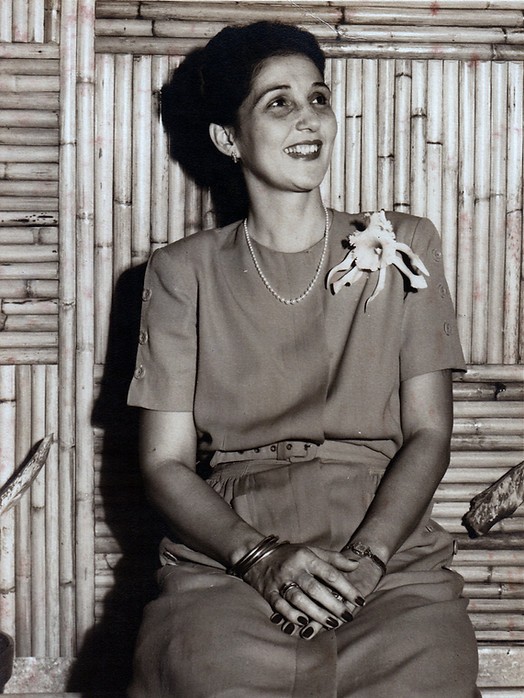
Maria Montenegro Aboitiz
We went to Baybay before the Japanese came to Cebu. Then we went to Ormoc after the Americans already came there. The Americans had already landed in Leyte when we escaped Ormoc because Mother was pregnant with Vicki and we didn’t know whether there would be a doctor or hospital or whatever left.
After that, they never bothered us because we were very low key. We went to school in Sta. Teresa. First, with the Redemptorist fathers where I learned to speak a little bit of Latin, and then the nuns of Sta. Teresa, which were my best school years - first and second year of high school.
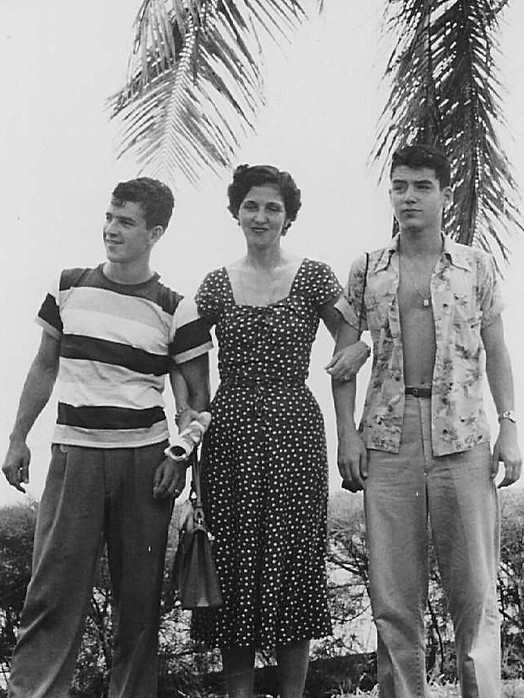
Louie, Maria, Ernie, Miami, 1950
During the war, Ernie and I used to wait for a car to come and then run across the road. There were only Japanese cars. There were no other cars. And then, we used to climb the santol tree on the edge of our property and throw mud balls at the Japanese cars. God knows what would have happened to us if we had been caught.
When I was 12 years old, in 1942, I got into a slingshot battle, a play battle, and since I was the oldest, three younger kids ganged up on me. One of them must’ve had good aim. When I came out to peep, he got my eye.
That was traumatic. I don’t even like to talk about it. I had to go and be sent by bangka to Manila. Then from Manila, I had to go on a tartanilla to Tarlac. It took us three and a half days.
There was a famous eye doctor there, Dr. Santos. He was famous in Manila. He had to operate on my eye for cataracts, for what they would call traumatic cataracts, without anesthesia. Three times. The first operation was no problem. The doctor gave me something in my eye for the pain (note: cocaine). But on the third operation, even before I got into the operating room, I was perspiring like mad with fear.
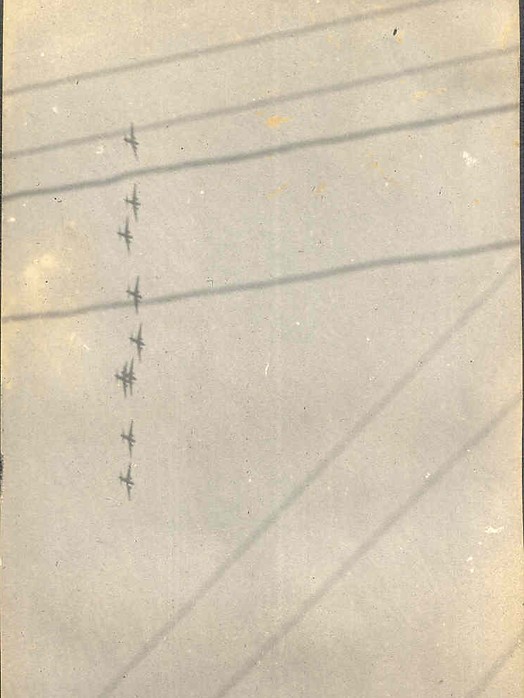
Photo by Eddie Aboitiz
There were several scary moments, especially when the Americans started bombing Cebu in ’43 or ’44. They would go right over our house to bomb other airplanes. On the second floor, we thought they were going to crash into us. The fighter airplanes were so near that we’d be looking to see the eyes of the pilot. That close because, naughty boy as usual, when everybody went to the bomb shelter, I hid and stayed behind to watch.
Our bomb shelter there was the septic tank, but I don’t remember it smelling bad. It had been condemned and cleaned out with steps going down. It was really safe because it was built of concrete, underground with a small opening.
Ernesto Aboitiz
3rd Generation, Luis Aboitiz branch, from his 1995 interview
I was nine years old when the war started and almost twelve when it was ending.
Cebu was different from Manila. Manila was an open city. Cebu, they burned half of it because Cebu was where the Americans stored materials that were coming in and there was ammunition, food, and fuel, which they were using to shunt out to Bataan and Corregidor. So when the Japanese invaded in April, they had all that stuff here and the Americans burned it. They burned half the city and, in fact, day became night almost from so much fuel that went up. And the difference, like I say, is Manila was hardly touched – then. A lot of people left Cebu but we stayed.
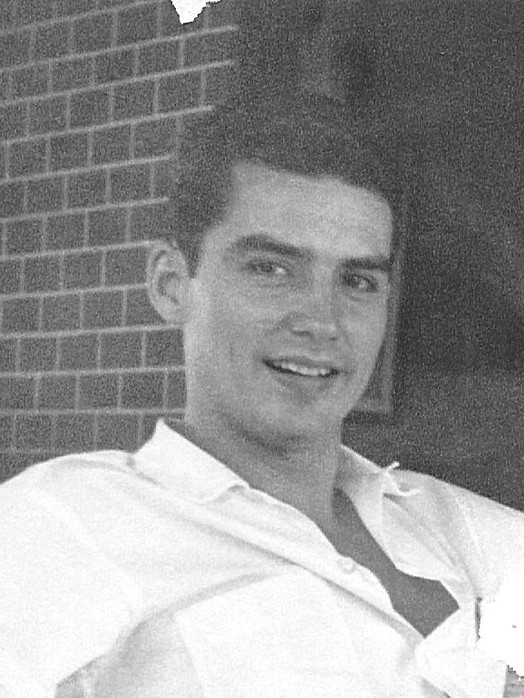
Davao, 1955
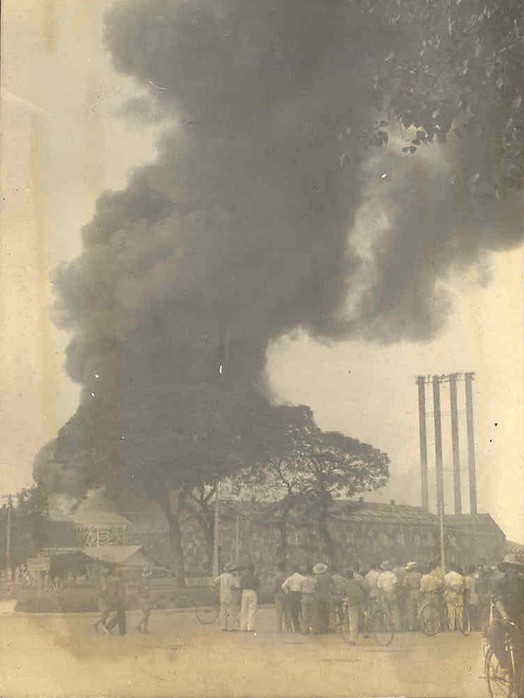
Photo by Eddie Aboitiz
We all stayed. For a short time, we went to Baybay. First, Liloan, which is very near. Then, Baybay, and then they decided to bring us back. I think we had ships from Sorsogon still coming through because Sorsogon was still held by the Americans. These ships were coming in and I remember that some friends came through from Manila and they came with stories that nothing happened.
So this is when everyone decided that we might as well come back to Cebu rather than be out. And it was a good move because if we had stayed outside, all of the properties here, of course, would have been taken over because, at least the houses, if you were there, the Japanese, they did not occupy the houses. And the old folks, they worked until the last day until the Japanese came in. They were trying to hold office, hold the fort, in effect, until the Japanese came in.
The war years, again, Cebu was different from Manila because there was quite a lot of guerilla activity, successful guerilla activity. Cushing was here in Cebu. And they really had the Japanese surrounded. Then, the bombings, like everywhere else, this went on from September, in the case of Cebu, till close to May -- continuous bombing, almost daily. Of course, this affected the civilians very much. The difference here, between here and Manila, there weren’t the killings that occurred towards the end.
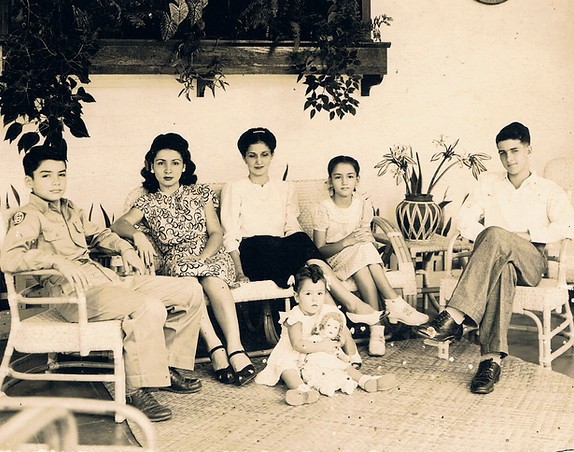
Ernie, Josephine, Maria, Cely, Louie, and Vicki Aboitiz on the floor, 1946 Cebu
Mother (Maria Montenegro) was pregnant, so by January, they took the decision to leave. It looked like it was going to get rough in Cebu. Food was getting scarce. The Japanese were getting more irritated. They had lost Leyte already. By that time, it was definite that they could see the end in sight. So this is why there was a fear that there would be something like Manila so we left.
We didn’t know what had happened in Manila . . . tremendous killing. We went via Bohol. We went to Baybay, Leyte. That’s were Tio Jesus Moraza was. We knew that. And Tio Fernando was there too. And we had some sort of resources there. So that was the place to head for. By the time we went across to Bohol, Bohol was already guerilla territory. It was no longer in Japanese hands. The Japanese, at that time, were really encircled. They were just holding the city and a few other major places outside. They could hardly even go between one place and another because they would be incessantly bombed and the guerillas were quite strong already and they would attack them.
Judging from the losses in a lot of different families in the Philippines, the Morazas and the Aboitizes during the war were quite lucky. We didn’t lose any lives. Even though the family of Paulino Aboitiz went through the massacres in Manila, they weren’t killed. We were fortunate in that regard.
Before the war ended in August 1945, we had come back here already after Cebu was liberated so we were here about late May of 1945 when we came back.
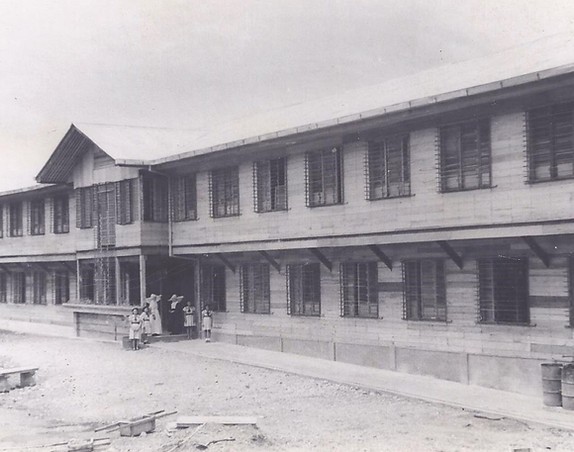
Asilo Orphanage
I was already old enough to remember everything and, of course, when we came back here, a place like Cebu, it was completely devastated. Our old house was bombed to smithereens. That’s where the Asilo is. Fortunately, Tio Ramon and Tio Vidal’s houses were not destroyed. So that helped. It was a question then of trying to build up the business, which, of course, I did not participate in because I was still in high school. We also had to go back to school right away and that’s what we did. Now, some of the older ones like Hank, their schooling was broken during the war. In our case, it wasn’t because we studied some with the priests and some by ourselves. We went to Sta. Teresa for a while. We tried to play catch. By the time the schools opened, they would give these exams and we passed the exams. So we were able to be going to high school already. I was fairly young in spite of the war. I graduated when I was sixteen years old. So you know, it didn’t really affect my schooling except that you can say that a lot of the education was self-education along the way during the war.
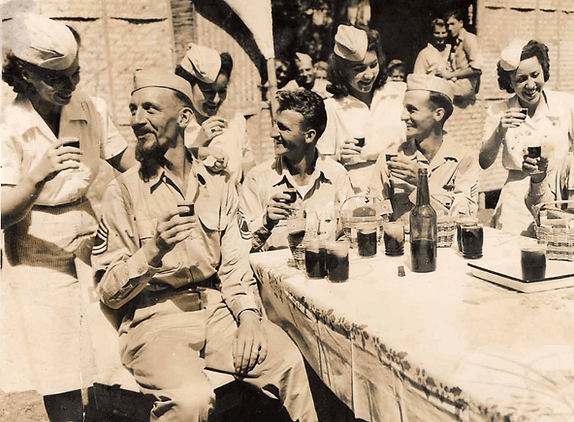
Cheering up the troops. Maria Luisa Aboitiz Canova, Carol Aboitiz Diaz, Josephine Aboitiz Booth, Miren Aboitiz Achaval
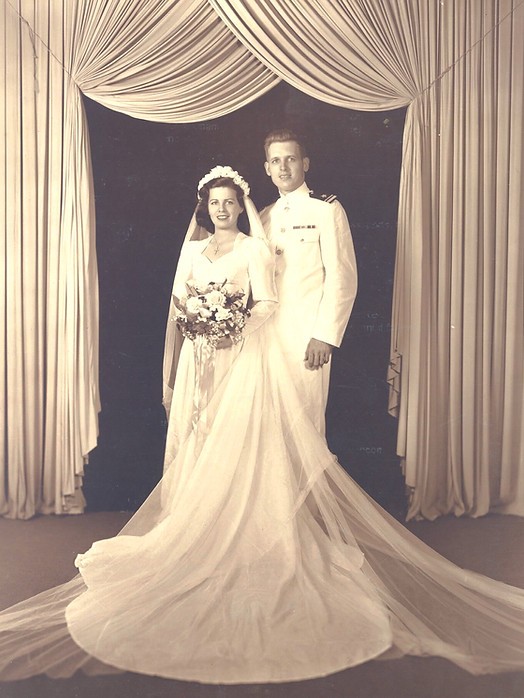
Maria Luisa Aboitiz and Edson Canova
Our sisters, Josephine and our cousins, they were, of course, very much in demand when the G.I.s were here. There were an awful lot of them but the only one that got married was Maria Luisa. She married Ed Canova, a handsome young ensign at that time. Ed participated in the landing in Cebu, in Talisay, and also Davao. He was the skipper of an LCI. I think Tio Ramon wasn’t too happy about it because Ed was going to participate in the landing of Japan and we knew then that the odds were going to be very bad. So it really didn’t make sense to get married and then hike off to a very dangerous assignment but you can’t stop love. And as things turned out, the war ended because of the nuclear bombs. So fortunately, he was saved from that. He did not go on to Japan.
Mercy Moraza Gimenez
3rd Generation, Jesus Moraza branch, from her 2019 interview
I was born on August 3, 1944 during the liberation of the war against the Japanese in the Philippines. I was born in Baybay, Leyte. During those times, we didn’t have hospital facilities, so my mother gave birth in my Tia Liling’s house in Baybay. My mother and dad had left Cebu, where they used to reside, and moved to Baybay, Leyte because of the war. They thought that it would be safer to live in Baybay where things were not as bad.
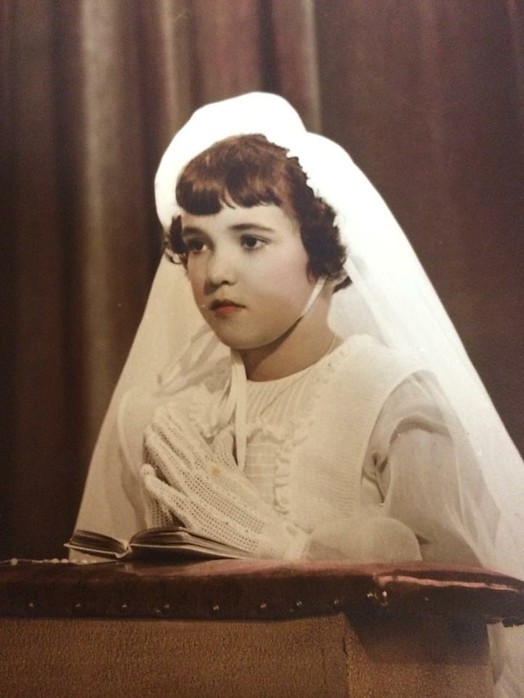
Mercy Moraza Gimenez
So we lived in Leyte during the war. My father was helping the Americans. He had his own ways of listening to what was happening with the war and how it was going. He had a radio, from what I heard. He was helping the Americans, but he was also very close to the Japanese. Both would come to the house very often. That was something we had to be very careful with.
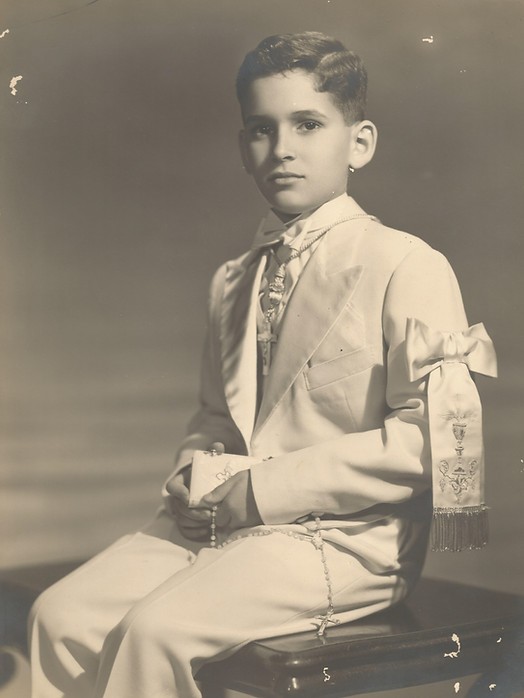
Jose Mari Moraza
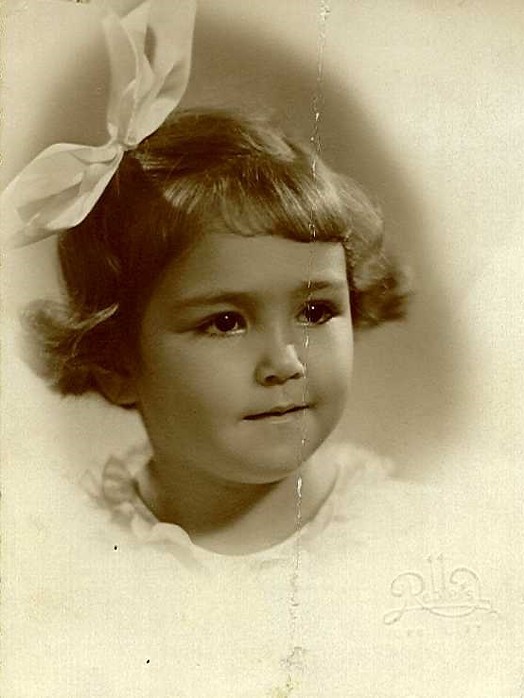
Vicki Aboitiz Cody, 1950
Tio Fernando and Tia Elena Moraza, had also moved to Baybay, Leyte. They were living in the Aboitiz & Company house, which was by the beach. Tita Antonia and Tito Isidro must have been there because Jose Mari Moraza, my nephew, was born in 1944 in Baybay. Tia Maria Aboitiz and Tio Luis must have been there as well because Vicki Aboitiz Cody was born in 1945 in Baybay, Leyte.
I have no knowledge of the war whatsoever, since I was born in 1944, but I was made to understand by my mom (Pepita) that Abuelito (Jesus Moraza) had a lot of documents and a lot of cash. The documents had belonged to Aboitiz and Company and he hid them with him in Baybay. He had all this in boxes.
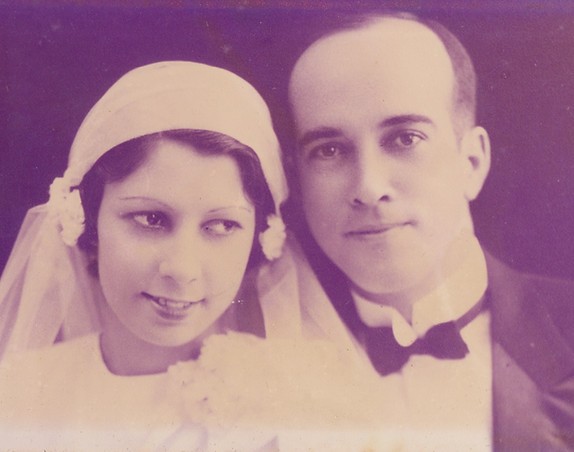
In fact, when my father contracted Parkinson’s disease, he had memories of the war. He would always ask us, ‘Where are the boxes under my bed, where are the boxes under my bed?’ That’s why I asked my mother what boxes is he talking about. Apparently he was hiding quite a bit of boxes for Aboitiz and Company. After the war, he turned it over to Tio Ramon who was the head of Aboitiz and Company.
Isidro Moraza
3rd Generation, Manuel Moraza branch, from his 1995 interview
My father had a ranch, but it was not cattle, it was carabaos (water buffaloes). He would buy female carabaos and he talked to somebody here in Cebu and imported water buffaloes from I don’t know where. He imported the male buffaloes and they would cross with the local female carabaos here and get the mestizo buffalo. The advantage of that was that the offspring of these buffaloes could work straight. No stopping-stopping. The local carabaos of ours cannot work very long. They have to go and wallow in the water and the mud there for a while and then back to work while the mestizos . . . There was a big demand.
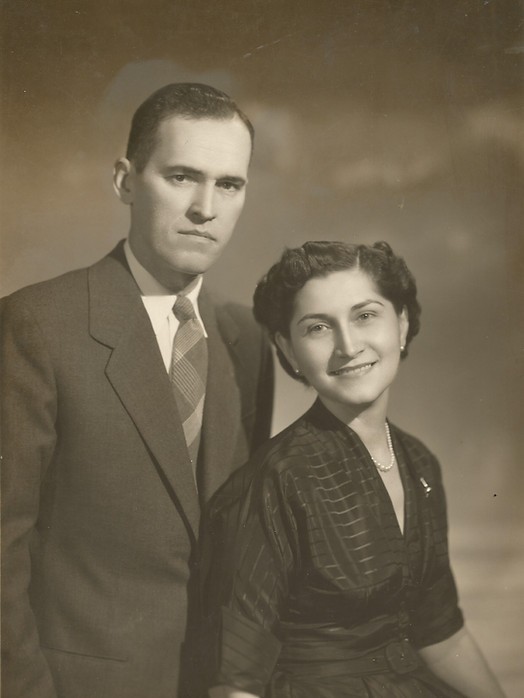
Isidro Moraza and Antonia Roig
When the war broke out, our dear government used the animals to pay the Philippine soldiers. Instead of paying them cash for their salaries, they paid them with that. If you were a captain, well, you got three heads. They ate up the whole caboodle. Nothing was left of the ranches. Only the land was left.
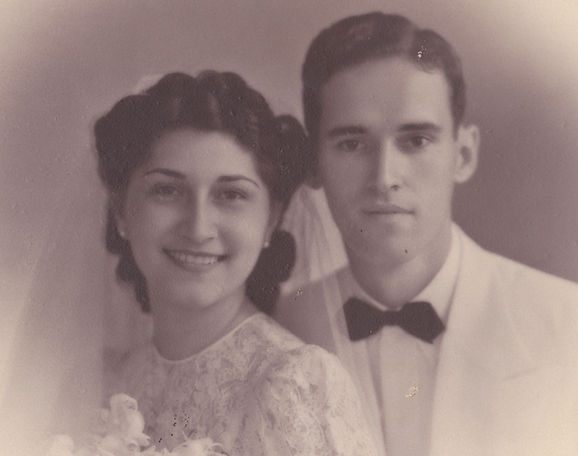
Antonia and I got married in May and in December, the war broke out. During the war, we stayed with my mother (Martina Arizaleta Moraza) in Banilad. The women of the family went to Baybay during the war, except for us and the family of my sister, Paquita (Moraza Gonzalez).
Of the men, the only one who went to Baybay was Tio Luis. Tio Luis had a nervous breakdown. He was worried about small things like what the sailors and our boats were doing tied up in the harbor in Cebu. So they sent him there to rest while all the men, we stayed here. We even lived for a while, all of us, in the house of Tio Vidal.
The war started December 8 here and Maribel was born February 17. So we went to Danao where the doctor was. At that time, a lot of people evacuated from the city and this Doctor Blanco, who was a very famous doctor in Cebu, had evacuated to Danao, thirty kilometers from here. Antonia was still in Cebu City and she had to give birth so we transferred to Danao also.
We rented a small house down there and stayed there. That’s where Antonia gave birth in a schoolhouse. We were fortunate that this schoolhouse was fairly new. It was a Domestic Science Building or something like that and they had a kitchen there. That’s where she gave birth and her birth was a long one. More than twenty-four hours walking back and forth. We couldn’t stand it anymore. Paquita would walk with her for a while, I would walk with her for a while, Rose (wife of Joe Moraza) would walk with her for a while, all of us took turns to walk with her. More than twenty-fours was her labor.
Mind you, at that time, everybody was afraid about the Japanese planes coming, even at night. They never came but everybody was afraid. So in that school, we had to put papers on all the windows so you could put your light on in the inside and it would not go outside because the planes might see it. We had to shut it off. They were very strict on that. It was all difficulties but anyway, we went through it.
After Maribel was born, we went back to Cebu. We lived in Mariano’s (Gonzalez) house because the Japanese were already in Banilad. They occupied the house. We couldn’t even go.
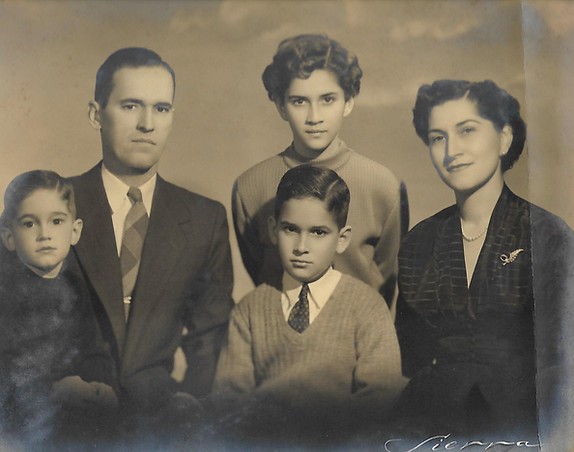
Jaime, Isidro, Maribel, Jose Mari, Antonia in Madrid 1954
One very funny experience we had with the Japanese with our house in Banilad was that one day they came to Mariano’s house where we were living. The Japanese were very curious people. Those guys, they would always come looking at everything. To make a long story short, one fellow one time looks at Antonia and says words in Japanese making signs with his hands pointing to her head. We couldn’t understand him. He knew that we couldn’t understand so he made signs that he would come back tomorrow. He came back the next day and you know what he gave us? The picture of our wedding! The signs he was giving with his arms going up and down was the velo (veil) of the wedding. That was her picture.
Rosario Moraza Planas
3rd Generation, Fernando Moraza branch, from her 2021 email interview with Chary Planas Prat
I was born in Baybay, Leyte in a bedroom of my uncle's house (Manuel Moraza and his wife, Martina Arizaleta). The house had coconut trees growing in the backyard, which faced the beach. This house has many memories for me as it was like a house of refuge the first time we evacuated to Baybay. This was before the Japanese came to Cebu.
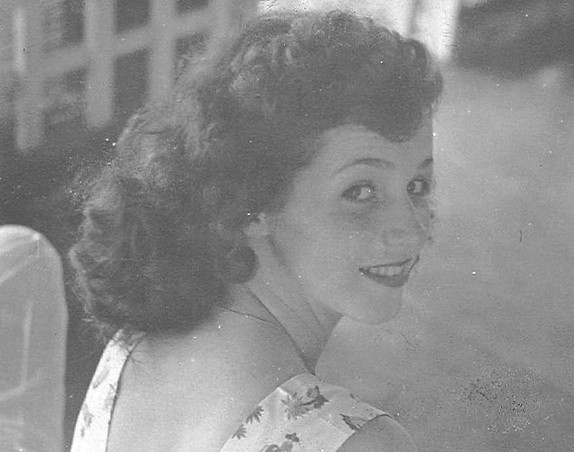
When the war started, we were at school in St Theresa’s College. I was 12 years old. We were all surprised by the sudden bombings. Mother Superior gathered the students and took us down to the ground floor level where we prayed. Papa (Fernando Moraza) picked us up and took us home. School was suspended for a while. When classes resumed, we had to learn to sing the Japanese national anthem.
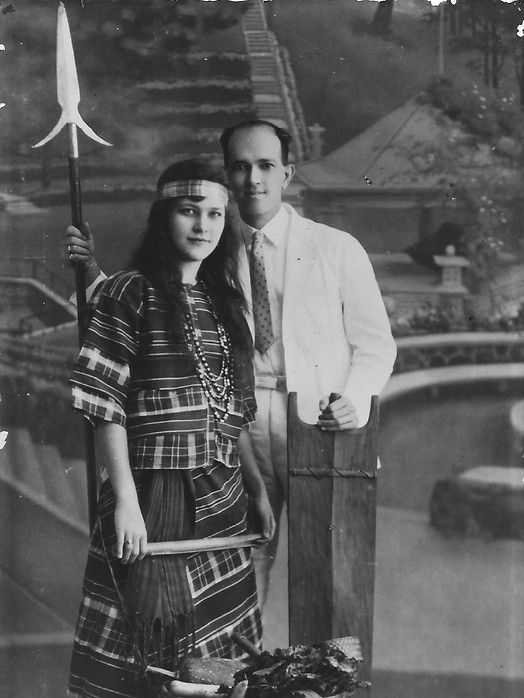
Elena Miciano and Fernando Moraza Honeymoon in Baguio
Years later, before liberation, we all decided to live together in one house in Cebu. Each family had a bedroom – our family, Isidro and Antonia, Tia Martina, Joe and Rose Moraza with their son Donny. The house was near Tio Ramon and Tia Lolita’s house. The house we shared had a vegetable garden initiated by Papa.
News about the war was heard on our radios, which were kept secret and we were informed that liberation was coming. During the day, cousins (Antonia Moraza and Maria Luisa Canova) taught me how to knit. Other families in the same area would visit us and have merienda together.
It was discovered that there was a warehouse of solid concrete at the back of the house. The men dug an air raid shelter there, which had benches for us to sit on. Some nights, there were lone bombers and we concluded that they were American planes trying to tell us that they were coming to liberate us from the Japanese. We took our pillows to the shelter when being bombed and would wait until a siren gave us the all clear signal.
The men in the family decided to plan an escape from Cebu to Baybay. These plans were made in secrecy. We escaped early one morning on a truck and proceeded through the back roads that had no sentry points. We did encounter one sentry and as we drove past, we heard the alarm sound but were already through by the time the guards made a move.
We went to a beach town where a banca (outrigger) picked us up. We had to wait until dark before getting into the banca. Only women and children went on that first trip besides Joe Moraza and a houseboy. The plan was to go first to Bohol before Baybay. In Bohol, we would get a bigger banca.
On the way to Bohol, there was a storm and we had to seek shelter in a small island. People with fire torches to guide them. They kindly offered us shelter in their houses. We were all soaking wet. We spent a few days in the small island, washing and drying our clothes.
The rest of the men from the family arrived after receiving a message sent saying we were in the island. After a week, we all proceeded to Bohol together. There were also other families in Bohol who had evacuated but were not related to us. The Americans had already landed in Baybay. Upon arriving in Baybay, we settled well and rented houses near Tia Liling’s (Angela Moraza). We also attended school in Baybay. During recess, the American soldiers would come and chat with us.
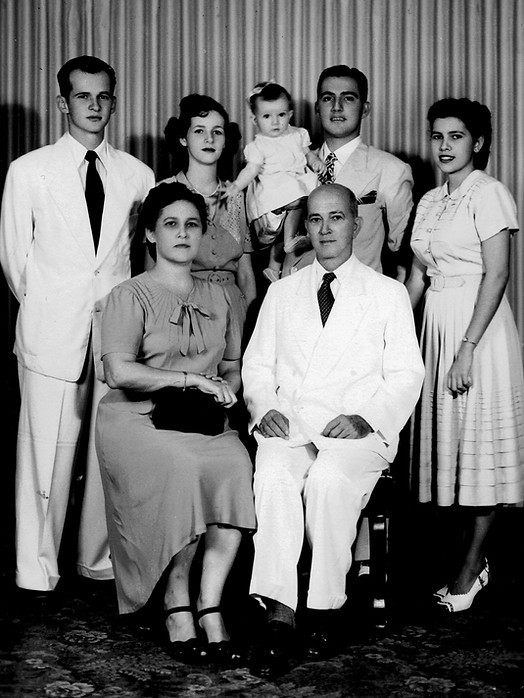
Seated: Elena and Fernando Moraza; Standing: Ramoning, Rosarito, Tony Planas holding Chari, and Teresita Moraza
After a few months, we went back to Cebu. The houses we had lived in were all burned down except Tio Ramon and Tia Lolita’s. The Japanese kempeitai (military police arm of the Imperial Japanese Army) occupied the lower part of their house while Tio Ramon and Tia Lolita lived upstairs.
Tio Ramon and Tia Lolita stayed in Cebu. Tio Ramon helped the Redemptorist priests when the Japanese tried to burn the church several times.
Teresita Moraza Mendezona
3rd Generation, Fernando Moraza branch, from her 2021 Zoom interview
When the war broke out I was then about nine years old in fourth grade. I was studying here in Cebu. My father (Fernando Moraza) was in Ormoc and he just used to come weekends to visit. In the beginning when we were younger, we studied in Ormoc but then my parents decided we would study in Cebu so we came here with my mother while my father stayed in Ormoc because his work was there in Hacienda Ma. Teresa, a sugar cane plantation owned by Aboitiz and Co.
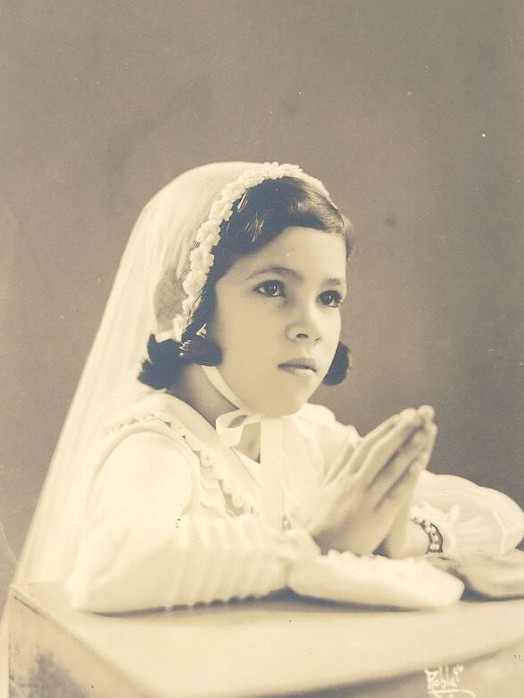
When the war started, it was December 8, 1941. It was a holiday, a day of obligation for Catholics so we didn’t have classes. We didn’t go to school that day. The following Monday the school had closed already. We didn’t know what was happening, what was going on and the whole Moraza-Aboitiz clan evacuated to Baybay, Leyte. The ancestral home of the Morazas was in Baybay and of course, we couldn’t all stay in the house. It was not so big. So each one of us found a house somewhere in town. It was not a city then.
Then, the rest of the family (including Tio Ramon and Tio Vidal) returned to Cebu. I think the Japanese were on their way to Cebu. The only ones who stayed in Baybay were my father and Tio Jesus (younger brother of Fernando).
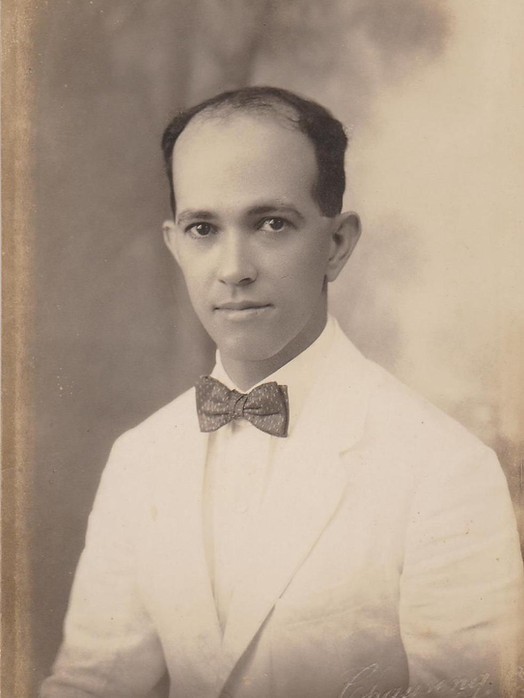
Fernando Moraza
The Japanese were already in Ormoc but they did not come to Baybay until much later. You know, there was no fighting in Baybay. When they finally came in, they just came in. My parents and Tio Jesus were staying in one house. The Japanese came to the house and they talked to my father and my uncle outside. The women and children were all inside in the house. At that time, the Aboitizes had a bus company, West Leyte Transportation. So they told my uncle that they wanted to see him the next day in the headquarters.
The Japanese found a big empty house and they settled there. So the next day, Tio Jesus goes there and of course, the Japanese told him, “We are going to confiscate all transportation. You cannot operate that bus company anymore. It has to be surrendered.” In spite of that, we still stayed in the house (the big house by the beach which was beside the bus company). They did not tell us to get out
There were many houses there that were not occupied. So the Japanese stayed in those houses. The Japanese that were sent to Baybay were relatively good. They did not harm anybody. This is funny. People from Baybay would go to Cebu and find that there were sentries every so often. They didn’t know that in Cebu, civilians who passed the sentries were supposed to bow. So the people in Baybay would come to Cebu not knowing they were supposed to bow and they would get slapped. The mayor of Baybay had to give an ordinance that everyone should bow when they passed a sentry. There was a very long street where the house was until the church. In between was a house with a sentry because the Japanese were staying in that house. And you know, when we would pass by with the maids to go to church, the maids would tell us, “Okay, everybody bow.” So we would all bow. And the sentry would turn his back to hide that he was laughing. He was embarrassed that we were bowing to him.
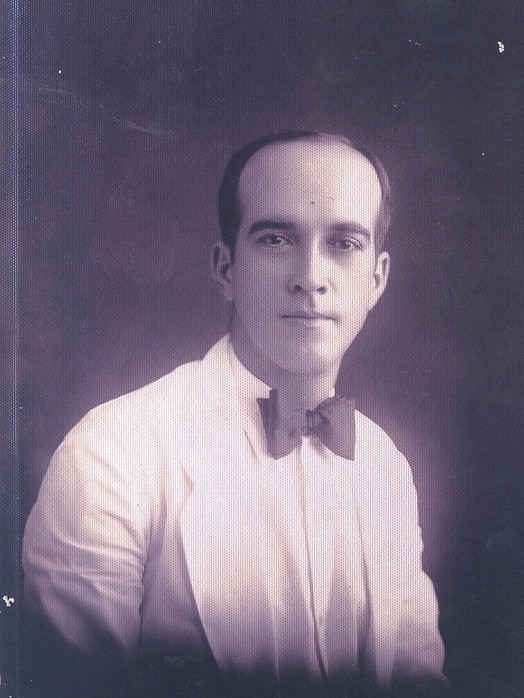
Jesus Moraza
After a while, the Japanese told Tio Jesus that he was wanted by the guerillas. They said, “We will help you leave. We will provide you with a boat to go to Cebu. You cannot stay here.”
Apparently, the guerillas wanted Tio Jesus because they thought he was helping the Japanese by giving them the bus company. But he was forced to do it. They would have cut his neck if he didn’t and they still would have taken the vehicles. What could he do? You couldn’t say no to them.
When Americans from Cebu would come here because the Japanese wanted them, they didn’t know anyone and the fishermen in the seashore would find them at night lost. They would bring them to my uncle. He would tell them, “You go to the mountains because you are not safe here in town. I’ll provide you with a guide.” He would give them money and food and off to the mountains they went. In spite of that, we were called collaborators.
So we left Baybay and returned to Cebu again. At first we were living again together in one big house. My uncle, Alberto “Betot” Miciano, the brother of my mother (Elena Miciano) played the piano very well just by ear. He would play classical music. One evening, he was listening to some music that the Japanese across the street was playing. Once in a while he would play it on our piano. Apparently, a Japanese listened and got curious. So the next day, he came to the house and they talked there. Of course, we were children and we were not allowed to be around but the next thing I know is that we had to leave the house because the Japanese needed it. The Japanese’ house was full of trees in front. We didn’t know that they were there across the street. So we had to leave. We couldn’t find a big house anymore so we had to live separately in two small houses in Lahug.
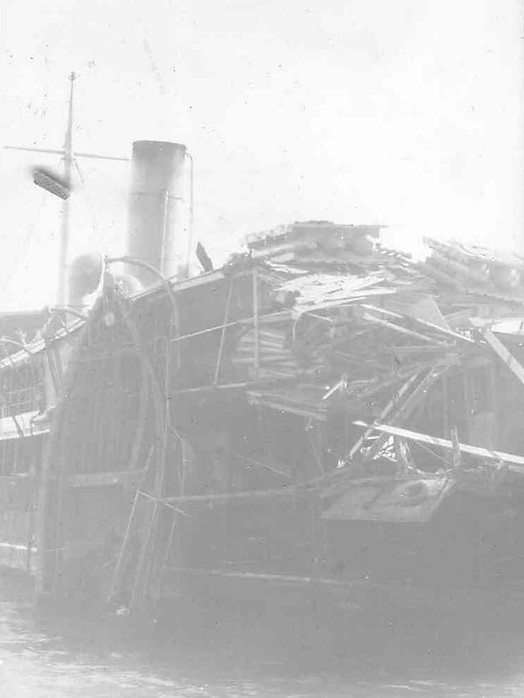
Photo by Eddie Aboitiz
During that time, St. Theresa’s opened, so we were going to school. Then, the Americans came and they started bombing. Once in a while they would come and bomb something. In the beginning, they bombed the airport, which was in Lahug where the I.T. Park is now. The Japanese told us to leave Lahug because it was dangerous since it was near the airport. The Americans also bombed the pier. That’s all I think they bombed.
So we moved to a house near Redemptorist Church. It was a big house and Isidro and his family were there. There were four families in that house. Each family had a room. Our family, the family of Isidro, Tia Martina the mother of Isidro, Joe and Rose Moraza and their son Donny.
The Americans started coming back. First it was Manila and then they started bombing again here in Cebu. Every day it got worse. They were using bigger planes and they would bomb and bomb. It got bad because with the big planes, you were never sure where the bomb would hit. They didn’t dive like the dive-bombers before. That one was always a direct hit.
My parents had a radio that they would listen to in the evenings. They were listening to what was happening in Manila – the killings and abuses. They feared that would happen here in Cebu. So we planned to get out, to leave Cebu again to return to Baybay. But the permission given was to go to Talisay. The mayor knew what everyone was up to because it wasn’t just us. Many other families were doing that. They would ask if they could borrow trucks for their things and the mayor would say yes.
Early one morning, we went to Talisay. The idea was from there to get a banca to cross to Bohol but we had the bad luck that when we got to Talisay, there were no bancas. The day before, the Japanese commandeered all the bancas and sailed them themselves for fun. The Filipinos did not want to go with them because they were afraid that the Americans would bomb or torpedo them. Besides, American patrol boats could just suddenly appear. And because no Filipino sailed with them, the Japanese all capsized!
So what do we do now? Late in the evening, a banca came. So now it was highest bidder for the banca. We were many so we all contributed and we got into the banca. We had to leave behind my father and Isidro, two house helpers and a brother of Antonia because we couldn’t all fit.
This was in the evening already. Bad weather showed up with very big waves. We thought we were going to drown. Everybody was crying and shouting. Rose Moraza (wife of Joe Moraza) was shouting. Antonia (wife of Isidro Moraza) threw her medallion of the Blessed Virgin into the sea. Maribel (daughter of Antonia) cried so hard, she fell asleep. Joe Moraza was our only man and Donny his son was still small. Ramoning (Teresita’s older brother) was a teenager. Later on, Joe said that he was looking at everybody thinking, “Who do I save first? My mother? My wife? My son?” Problema.
Anyway, there was a woman beside us seated on the outrigger dangling her feet into the sea. My mother asked her, “Do you think we are going to drown?” She answered, “Just pray to the Virgin Mary. I pray to her all the time and then just hold the outrigger.”
There was a big big wave, bigger than the banca. We would have really been covered by that wave. The captain of the boat hit the wave with his paddle and it broke in half and the water passed on the sides of the banca. We think it was a miracle as this happened about the same time that Antonia threw her medal overboard.
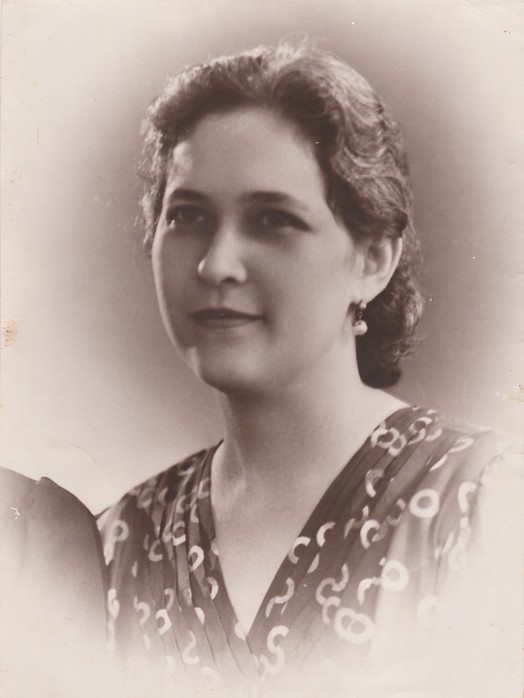
Elena Miciano Moraza
We landed in a small island between Cebu and Bohol. And apparently, the captain was from there. He lived there. The whole little island came to meet this banca. It was evening already. Maybe eleven o’clock in the evening. The captain tells us that we can stay in his house. We asked, “What about you?” He answered, “No, I can stay with relatives.” So, okay. Then, all of a sudden, my mother asks, “Where is my daughter?” It was my younger sister, Guadalupe, who passed away a few years later. A woman said, “There is a little girl there. She says she is cold.” “That’s my daughter!” My mother went to look for her and there she was looking at everybody and all the children were looking at her as if they saw a ghost because she was very fair with dark hair and very big eyes. They had probably never seen anyone like that.
The side of the island facing Bohol was very calm while the side facing Cebu was a little rough and that’s where we came from. The next day there was a banca from Bohol so we sent it to Cebu to get my father and Isidro with two of our helpers. They were from Dumaguete. One of them was our yaya (nanny) who ended up staying with us for thirty years.
The next day, we found a bigger banca and we all went to Bohol. We slept there one night and we found an even bigger banca to go to Baybay. We spent the rest of the war in Baybay. The Americans came. The Japanese surrendered and we were still there.
Tia Maria (Maria Montenegro Aboitiz) and her family were already in Baybay we arrived. So was Tio Jesus. They left Cebu ahead of us because Tia Maria and Tia Pepita were pregnant.
When the Americans returned, everybody little by little went back to Cebu. We stayed behind for a while and we even went to public school there for one year. My parents continued to stay because of some business of Aboitiz and Co. but they sent us to Cebu to become boarders in a school in Carcar. There was a Catholic school there that was a branch of St. Theresa’s. It still exists but it doesn’t belong to St. Theresa’s anymore.
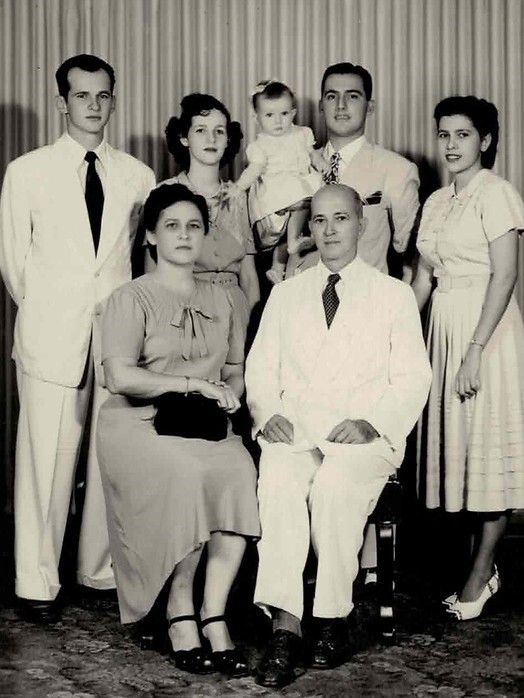
Fernando Moraza Family, Cebu, 1951
Standing: Ramoning, Rosarito, Tony Planas holding Chary, Teresita
Seated: Elena, Fernando
Remy Moraza Romero-Salas
3rd Generation, Jesus Moraza branch, from her 2019 interview
I had a sister, Rosamari, who died during the war. She was aged one and a half. My mother (Pepita) found her dead in the bathroom playing with the water. We went to Mass, we came back, and this little kid used to come out and say, “Ata.” to my mother. That day she didn’t come and my mother said, “How funny.” And you know, my mother had this fear. She was scared that one day she would drown. During the Japanese time, all the water that was collected was in timbas (big pails). We didn’t have running water. We had to make tabo-tabo (use a water dipper). So she ran to the bathroom and truly she found her dead. But she did not die by drowning because her feet were planted on the ground and her upper body was slumped, her half body was floating on the water. Nature tells us she would have pulled herself out for survival. I think she had a heart attack. She was born during the war so they didn’t know if she had a heart murmur or something else. They pumped her lungs and no water came out. She died in 1942. I must have been seven years old. I remember that incident very well.
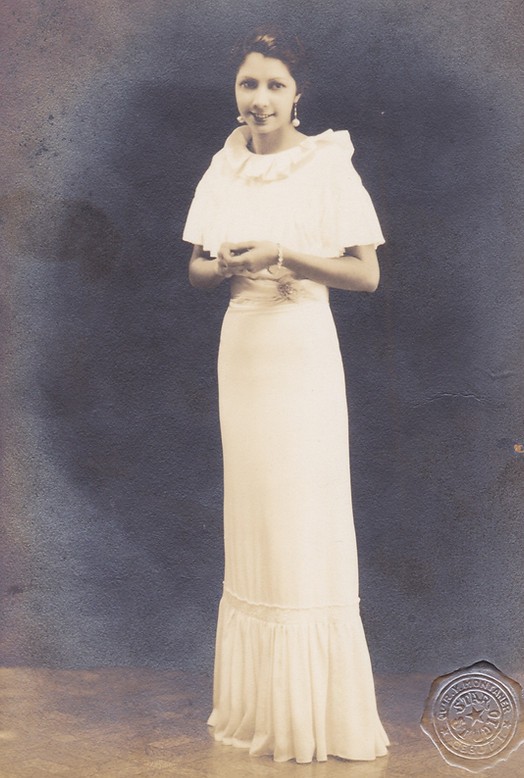
Pepita Mendezona Moraza
We lived in a house where Tio Fernando was. The two families lived together in this big house in Cebu where Mehitabel (rattan furniture factory of Maria Montenegro, wife of Luis Aboitiz) was on Mango Avenue. It was a huge house with a tennis court. My father (Jesus Moraza) and Tio Fernando rented or lived there without paying. I heard that some people just went into abandoned houses and lived there without pay.
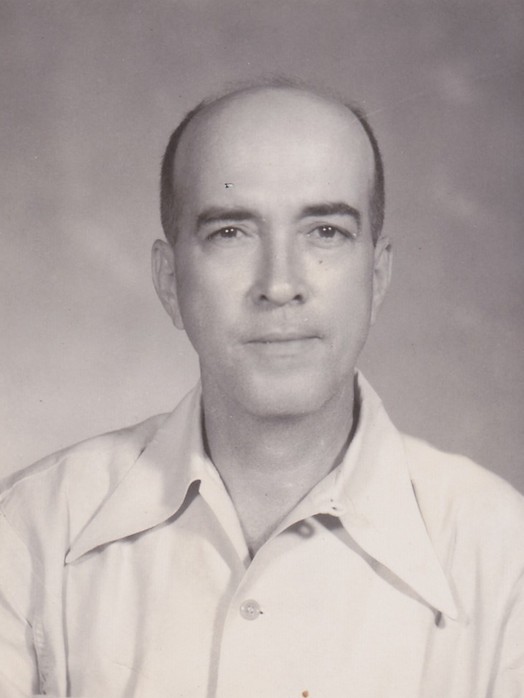
Jesus Moraza
The stories I will tell now are the stories of a child and the stories that my parents told me later on. Tio Ramon told us all to go to Baybay. He put my father in charge. He took a boat from Aboitiz. I think it was the Kulambugan (captained by Roque Moraza, one of the Moraza brothers). It was all the women with my father. All the men stayed in Cebu and so we went and we stayed in Baybay and we lived in two houses - Tia Liling’s house (Angela, sister of Jesus Moraza), which was the ancestral home and the house by the beach. Tia Liling’s house was inside the town about three blocks from the Plaza. Vicki (Aboitiz Cody) was born in a little house that was across from the church. It was where Tia Maria and Tio Luis used to live. That I remember. Tia Maria gave birth in that house.
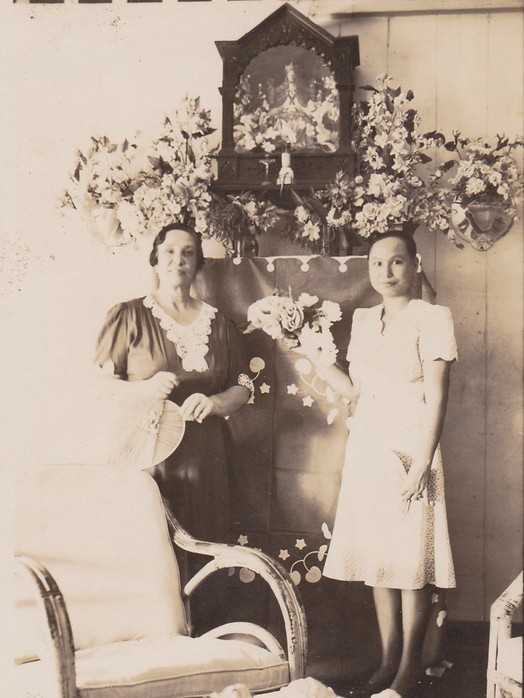
Angela “Liling” Moraza in Baybay
When I was a little girl, I thought the house of Tia Liling was huge. It had a well that was spooky looking. On the second family reunion (1995), Ernie Aboitiz made an arrangement to go to that house and I look out the window and I see this well. I say to myself, “Huh, what a puny looking thing.” But when I was a kid, it looked spooky. This was the home of my grandparents, Angel Moraza and Guadalupe Yrastorza. When everybody got married and moved out of the house, the brothers, because Tia Liling was a spinster, all gave it to her. So it became her house.
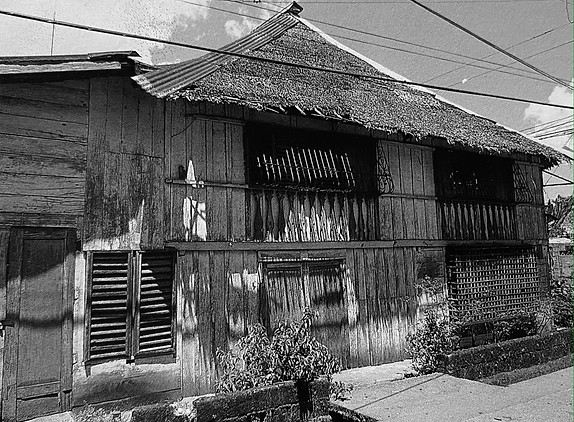
House of Liling Moraza
The bottom of the house was a big silong (open-walled floor underneath the house) but closed. It had doors. It had a store, a bodega (storage room), and we used to live upstairs. It had three bedrooms and one bathroom, which was an outside bathroom. There was a cistern that collected rainwater and the bathroom was right beside it. It was a huge room with plenty vats of water and that’s where we would take a shower. The toilet was in a little cubbyhole. Basically it was a wooden plank with two holes.
The kitchen was a big table with apog (powdered limestone). They would cook the food there in clay pots and such but when I was a young girl, that kitchen wasn’t used. Tia Liling had a “modern” kitchen, which was an iron stove where you put firewood and there were different size rings on top. I think it was the old folks that used that other kitchen.
The windows were sliding capiz panels and below were the ventanillas (literally: small windows). The posts were made from big trees. They were exposed in the middle of the house. There were orinolas (chamber pot) in every bedroom. The helpers would come and pick them up in the morning, clean them, and return them to their place. They were very nice orinolas made of porcelain.
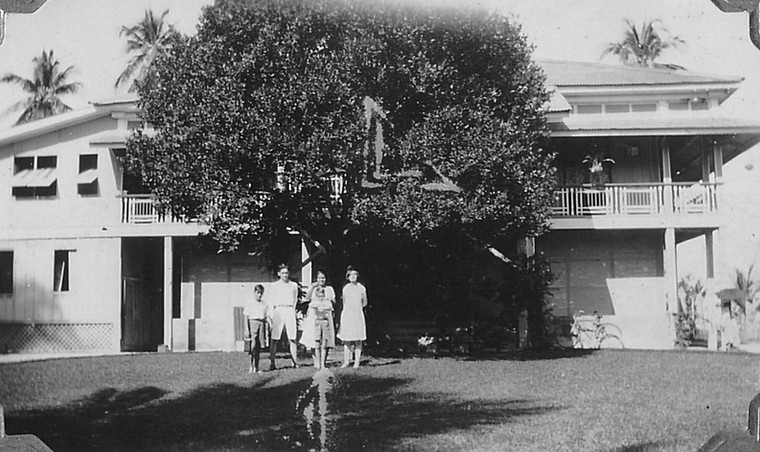
The big house by the beach, Baybay 1926
So I said that my father was in charge of bringing all the women and children to Baybay. He was already working for Aboitiz. And then suddenly, all the men came. You know, before the Japanese came into Cebu, they got worried. So they all left for Baybay. In the big house by the beach were Tio Vidal, Tio Ramon, and Tio Luis. Aboitiz & Co. owned the house. I think they sold it twenty or thirty years ago. I took a trip to Baybay because I wanted to see everything again. This is before we went on that family reunion trip in 1995. I think Aboitiz still owned that place during the first reunion in 1990. I really wanted to see that beach house. It was a beautiful house. It had a balcony all around that was by the beach and by the road. The rooms were in the four corners of the house. Again, one bathroom to shower and one cubicle was the toilet. And downstairs was a bodega, store, whatever. I don’t know if it was torn down or some Chinese bought it. It doesn’t belong to Aboitiz anymore. What I remember is that during the war, they had Leyte Transportation right beside. That ended after the war. Also there was the prenza (abaca press). It’s the one that strips the hemp.
The women and children stayed behind and the men all went back. When the big house by the beach was empty, my family including my father moved in.
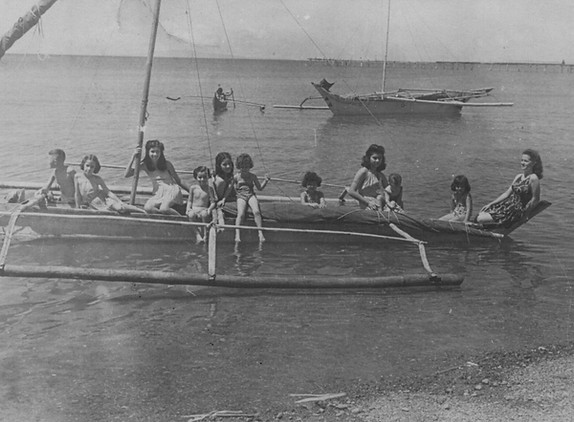
Sailboat, Baybay
Living in Baybay during the war was a big party in itself. We were by the beach, we were swimming every day, playing every day, no school. It was a big holiday for us.
All the cousins were there and we were all living in one big house. So it was always a game. Of course, our parents were worried but we were not worried. We were just having a ball.
My father used to befriend the Japanese and at the same time, he would facilitate any American coming through and have them in the house. He would cover up for them. It was dangerous. Then the Japanese came to Dad and told him, “Mr. Moraza, you better go to Cebu. You are in the hit list of the guerillas. They say that you are pro-Japanese. Immediately pack, we’ll give you a boat and we left. That was when we went to the Bunagan house where our sister died.
However, we went back one more time to Baybay because Mommy was pregnant with Mercy. They were hearing that the Americans were coming to invade and Daddy didn’t want to be in Cebu were the Japanese were. So he packed us all and Mercy was born in Baybay in a small house that we were renting. When she started going into labor, my dad shipped us all to Tia Liling’s house.
And then, all the Cebuanos started coming back to Baybay via Bohol. They were scared of Cebu again so they came back to Leyte. Baybay is where Vicki (Aboitiz Cody) and Jose Mari (Moraza) were born. When the Americans came in, the different families were still not yet with us. They were still in the Bohol area. Eventually everybody was in Baybay.
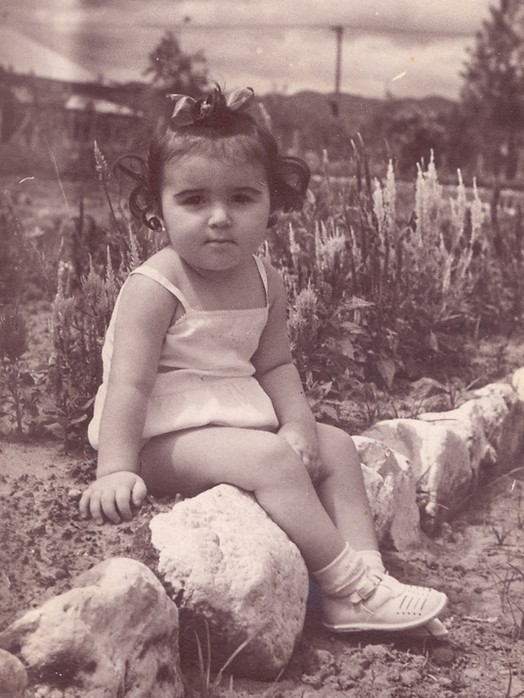
Mari Tere Moraza Rotaeche at the age of one year and three months
When liberation came to Leyte, it was the quietest thing you could think of. They threw leaflets that were signed by MacArthur, that is to say they printed his signature, to get away from garrisons, power plants, and water because they were going to bomb it. The net morning, they woke up and found that the Japanese had vacated the night before. They just left the town so the people there had an American flag and they put it up in a tennis court so when the planes came they started going lower and lower to look. After that, they came in from Tacloban on weapons carriers. That I remember. We were little kids and Mari Tere (my sister) had cute bucles (spiral curls) that were uso (in fashion). We’d put her in front of us and then the Americans would pass by and say, “Oh, how cute, how cute.” We would look up at them and say, “G.I. Joe, G.I. Joe” and then they would give us chocolates! That I remember very well. We stayed for a while in Baybay after the war and then we went back to Cebu.
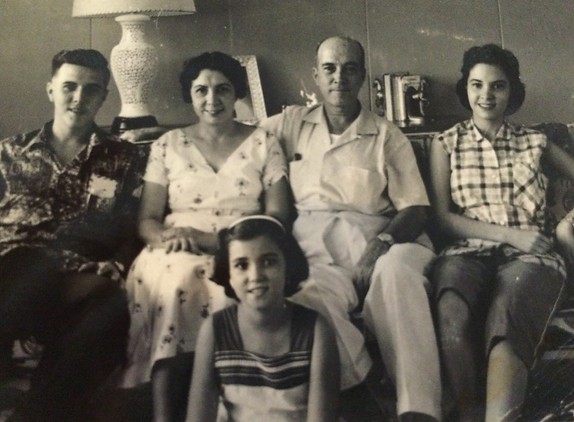
Manoling, Pepita, Jesus, Remy, and Mercy Moraza (seated on the floor)
Mari Tere Moraza Rotaeche
3rd Generation, Jesus Moraza branch, from her 1995 and 2019 interviews
My father brought us all to Baybay to get us away from the war. I spent the war partly in Baybay, the later part when the Japanese were killing people already and infiltrating more in Cebu. I must have been about five.
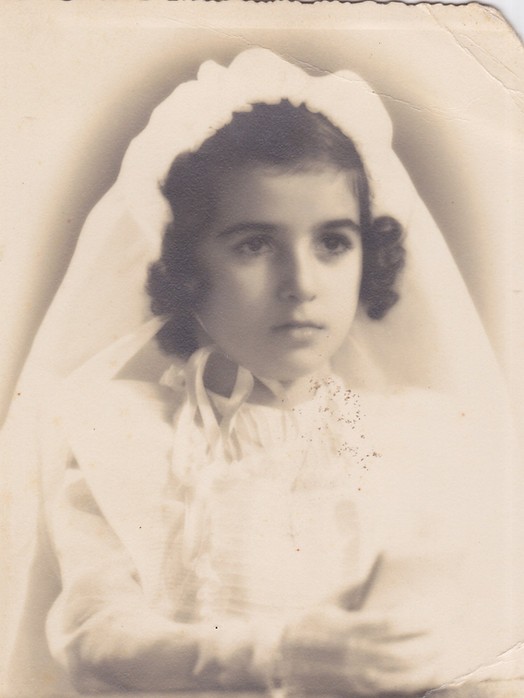
Mari Tere Moraza Rotaeche
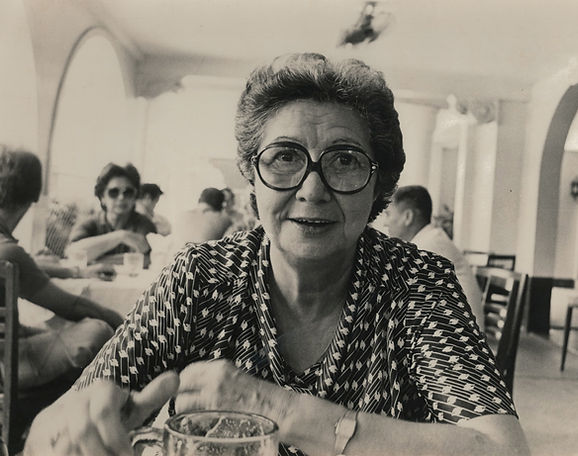
Pepita Mendezona Moraza
These are the stories my mother told us. She said our flour was from the trees, al fresco (fresh). We had nothing. The bread, we had to bake it ourselves. The soaps – my mother had to make it. There were no raw materials. When the Americanos came, they would give us chocolates . . .
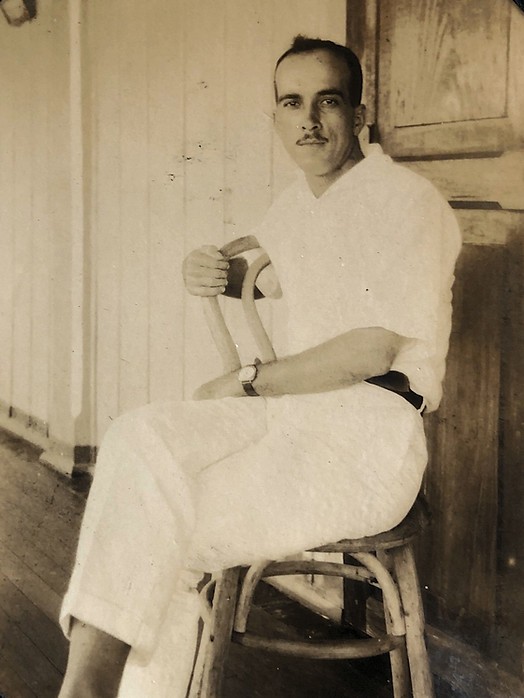
Jesus Moraza
We didn’t see the violence that was happening in Manila but my mother told me there were Japanese there already in Baybay and you had to play ball with them. So there were some generals who were close to us so we could go from one place to another by asking them for travel passes. That’s how we went from here to Baybay. My father had to get that to bring us to Baybay in a small bangka, I think
Ramoning Moraza
3rd Generation, Jesus Moraza branch, Chapter 3 of his book, "With These Hands"
At the beginning of the school year of 1940 – 1941, my parents decided to rent a house in Cebu. My mother stayed in Cebu to look after me and my three sisters. I was then completing my first year of high school in San Carlos College, while my three sisters were students at St. Theresa’s College. In the meantime, my father continued working in Ormoc as manager of the Hacienda Maria Teresa and would come to Cebu only on the weekends.
It was December of 1941 that the Second World War started. The Japanese attacked Pearl Harbour in Hawaii and eventually invaded the Philippines.
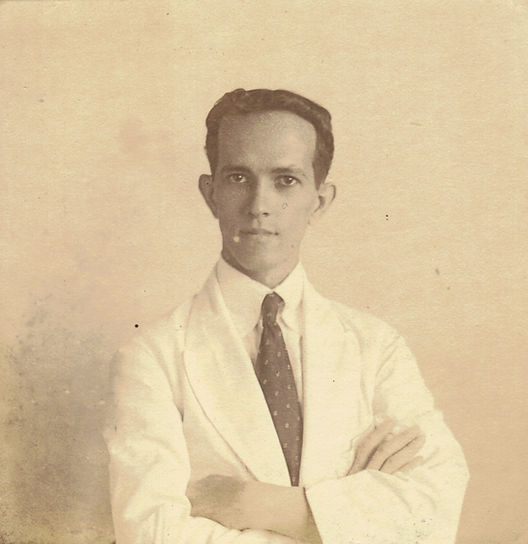
Fernando Moraza, 1918
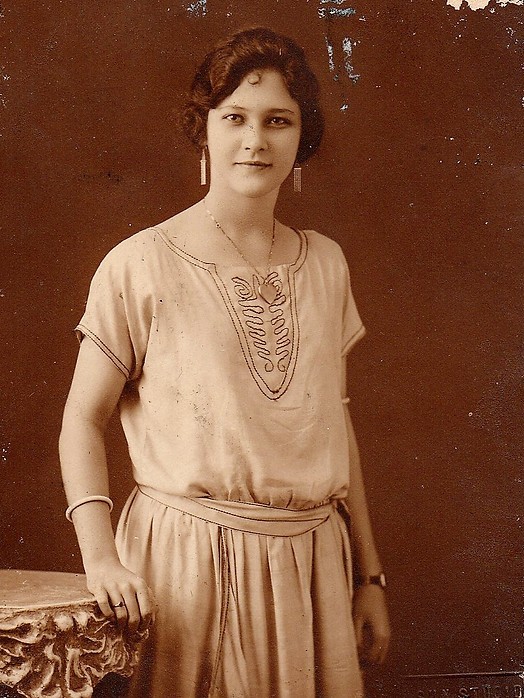
Elena Miciano Moraza
Following the general feeling of insecurity and “evacuation madness” that prevailed among the general population of the country, all the schools closed down. Those who lived in the cities did not feel secure unless they moved to a small town. Those who lived in the smaller towns did not feel secure unless they moved to the countryside. Fortunately, there was never any housing shortage, as evacuating families would just occupy the house that had been vacated by others who moved to what they believed was a safer location.
Many of the Aboitiz and Moraza families who lived in Cebu decided to evacuate to Baybay, Leyte. My father, with his family, decided to leave Ormoc and join them in Baybay as well. Although I was too young to realise this then, the main motivation for all these families to move to Baybay was for strength and security in numbers. Baybay has always been noted for its peace loving and good-natured people, and it was also the birthplace of the first generation Moraza family in the Philippines.
It was not until the Japanese had occupied the town of Ormoc for some time before my father had decided to relocate and it was during these final days prior to the transfer that I witnessed a most ghastly incident. In our town of Ormoc, there was a man who possessed shamanistic powers, or at least that is how he liked to portray himself. He liked to go about dressed in a dark, sweeping robe with full sleeves. Whether or not he really was a mystic, his full beard, and his well-kept hair that fell down to his waist certainly gave him the appearance of one. The townsfolk generally regarded him with certain awe, although through time, he proved to be completely harmless more than anything else.
It was on this ill-fated individual the commander of the Japanese garrison, probably itching to use his samurai sword on a human being, decided to make a public show of the superiority of the Japanese samurai. Without warrant or provocation, he arrested this harmless mystic, who was then given the cruel order to dig his own grave in the town plaza.
Word quickly spread around the townsfolk that this man would be publicly decapitated that same afternoon. Unknown to my parents, I was among the huge crowd of onlookers that had gathered in the plaza that afternoon, unable to resist the temptation of what was sure to be a lurid spectacle.
The mystic, who was at that moment devoid of any semblance of magic powers, was blindfolded and made to kneel at one end of the trench he had dug, with his face towards the pit. The Japanese commander, wielding his gleaming samurai sword with both hands, declared menacingly in halting English that with one swift stroke he would decapitate this man's head and still keep it attached to its body.
And with one flick of his sinister weapon, the town shaman's head lay neatly severed, dangling off his neck only by the skin of his throat. As the convulsing body fell into the grave, there ensued a chilling cry of revulsion from the trembling crowd that had gathered around to witness this atrocity.
That night and many nights thereafter, I could not surrender myself to sleep, and when I did, was haunted by nightmares.
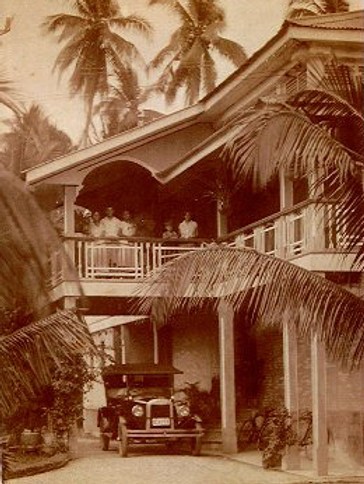
"The big house by the beach," Aboitiz & Company House, Baybay
Fortunately, we soon left for Baybay, far away from anything that reminded me of the incident. In Baybay, it did not take long for me to gather around myself a gang of kids my age. We would spend the time fishing, hunting, swimming in the sea, and roaming the town having fun in whatever simple way we could think of. As the months passed, the fear of war also settled down.
But outside Baybay's borders, the war raged on. Bataan had fallen to the Japanese, followed by Corregidor, then Manila. My father's family and Uncle Jesus' family decided to live together in what was known as “the big house by the beach”.
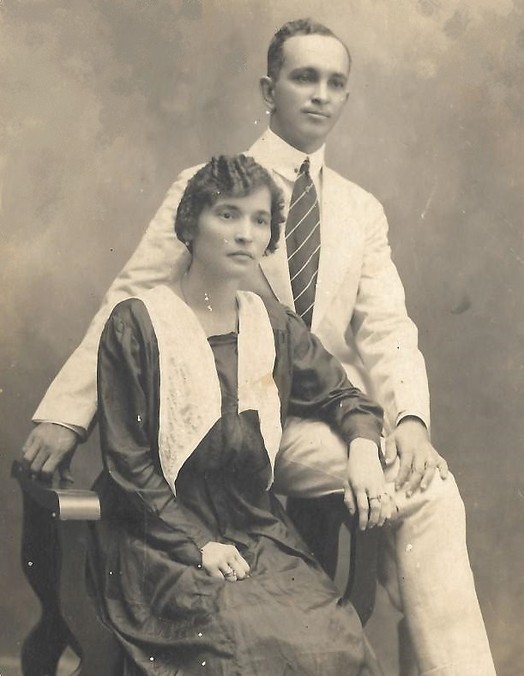
Martina Arizaleta and Manuel Moraza
Tio Manuel Moraza, who was my father's eldest brother, had purchased this magnificent big house by the beach from the Artadi family. Long before the war, Manuel had merged his thriving abaca business with Aboitiz & Company. In this merger went the big house, the building housing the abaca press, the wooden wharf, and the fleet of coastal motorised wooden boats that plied the south west coast of Leyte to gather the abaca fibre from the different local traders and agents.
This house was where I was to meet Mary, whom I consider my first love. The wife of Tio Jesus had a half-sister named Mary who lived with them and soon after we met, we fell in love. We must have been
fourteen or fifteen years old then. My life in close contact with Mary was indeed inspiring and always very pleasant. However, as fate would have it, as we grew older, we were always separated from each other for one reason or another.
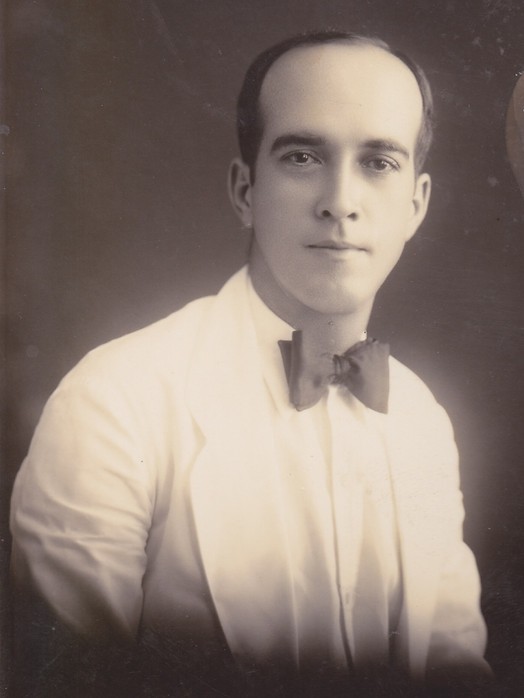
Jesus Moraza
While still a bachelor, Tio Jesus, the youngest of the Moraza brothers then worked as an assistant to his older brother Tio Manuel after my father was transferred to Ormoc. A few years after Tio Manuel merged his business with Aboitiz & Company, Tio Manuel died at the very early age of 49 from cancer of the liver. Tio Manuel's two sons, Joe (Peping), and lsidro, were still studying in the U.S. and his widow, Tia Martina, was left alone with her step-daughter Paquita, during Tio Manuel's illness, which led to his eventual demise.
A few years before the war, Aboitiz and Company formed the West Leyte Land Transportation Company. This company was based in Baybay and had its garages and service shops on a property between the residential house by the beach and the abaca press, better known as La Prensa. The resident manager of this new company was a certain Miguel Dela Cerna. This new venture was also organised and placed under the supervision of Tio Jesus Moraza. Eventually, Tio Jesus was moved to the Aboitiz & Co. main office in Cebu as an assistant to a Japanese executive and company director of the Fibre Department. This man's name was Tamesu Otsuka. Although Otsuka did not show any loyalty to the Aboitiz family during the Japanese occupation, nevertheless, he was employed again as an agent in Japan after the war.
But let us not forget the war. Before the Japanese Forces invaded and occupied Leyte, the U.S. Armed
Forces gave an order that all public transportation vehicles should be disabled and hidden in the countryside to prevent the enemy from utilising them. Immediately the mechanics and, some drivers started moving these buses to the remote hinterlands. The tires and other vital parts were removed and placed in other locations. I must have been about 14 or 15 years old then. Curious as I have always been, I was in the thick of all this activity.
Little did we know that those vehicles were not to last long in their hiding places. lt was during the
Japanese occupation of Baybay that the Japanese established their garrison in the Escaño &
Company house by the beach. Not long after, Sergeant Tanaka, the garrison commander summoned
Tio Jesus and gave him a time limit to bring back, and rehabilitate all the buses that had been immobilized and hidden away. Failure to comply would incur the penalty of decapitation. Needless to say, the activity of bringing back those buses was even more frenzied than when we were in the process of disabling and hiding them. Naturally, I managed to go along in as many recovery operations as possible. I remember during one of those incidents, as the mechanic was trying to start the engine by manually throttling the carburettor, the engine backfired, spraying alcohol and
setting my clothes on fire. I instinctively jumped and rolled on the ground to smother the flames off. The mechanics, unaware that my clothes were on fire, thought I was having a fit of some sort. To my amazement and utter confusion, one of them got down on his knees and begun to pull my penis. l later found out that this was their remedy for controlling an epileptic fit. We had a big laugh over it after everybody calmed down. We all decided that it was best that neither my father nor mother ever found out about this.
Aside from the episode with the hidden vehicles, the town of Baybay had a relatively uneventful occupation. There was one minor and rather anticlimactic incident that caused a bit of excitement in the town, when the guerrilla forces mounted a haphazard attack against the Japanese garrison in the outskirts of the town All we experienced of the attack was the sound of sporadic machine gun and rifle fire. By the afternoon everything went quiet and no casualties had been reported from either side.
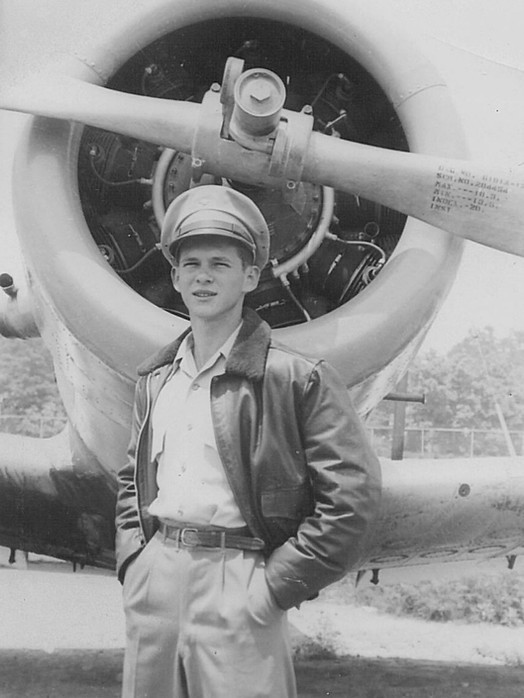
Ramoning Moraza, Flight school, 1948
I, on the other hand, lived contentedly in a world where I had my gang of friends, with whom I continued my usual routine of fishing and swimming; l and, of course, my girlfriend, Mary. Living in the same house made it easy to have frequent amorous contacts with her; and that they had to be kept secret made them even more exciting. As time passed, Tio Jesus must have noticed my affection for Mary. Although he never told me anything, his ever-watchful eyes were always over us when he could. Some afternoons, we would be taking a dip in the beach right in plain view from the back balcony of the house when least expected, I would observe that my uncle would be crouching on the veranda of the balcony with his powerful binoculars keenly observing our playful cavorting activities.
One day, the Japanese garrison commander, Sergeant Tanaka summoned my uncle Jesus to his headquarters for some grave news that greatly concerned him. Tanaka told my uncle that the Japanese garrison in Baybay would be moved out soon and that according to their intelligence reports, my uncle and my father were wanted by the guerrilla forces for having cooperated with the Japanese during their stay in Baybay. Tio Jesus was then given the option to evacuate to safer ground. The Japanese High Command would provide my uncle, my father and their respective families and household help transport out of Baybay, on a boat that would take us to Cebu City. Tio Jesus was given one week to decide if he would accept this offer or not. I have always wondered myself why Sergeant Tanaka had chosen to give my family such a generous offer. Perhaps, the fact that most Japanese during the war considered Spain a friendly nation could have been the reason for this gesture of concern by the Japanese High command. Sergeant Tanaka considered the Moraza brothers as Spaniards
After many a secretive conference between the two brothers, it was finally decided that we would all relocate to Cebu. The Japanese ordered a commandeered fishing boat from Iloilo City, the M/V Rosario, to proceed to Baybay. lt had an all-Filipino crew with one Japanese non-commissioned officer on board armed with but a single rifle. The M/V Rosario anchored a little offshore in front of the house by the beach where we all were staying, and after boarding the boat with our bare necessities; we sailed for Cebu that same afternoon.
During the evening we were caught by a sudden squall. To prevent the rain from drenching the passengers, the crew began to lower the canvas side awnings. The Japanese soldier in charge also got involved, giving orders in Japanese, which of course was not understood very well by the Filipino-crew. I remember seeing the Japanese officer sticking his hand through a mooring line hole just above the deck as he was trying to tell the crewman to hand him the awning line. He evidently wanted to secure the front end of the side awning and prevent it from flapping in the strong wind. As he spoke in Japanese, none of the crew took heed of him. In one decisive move the Japanese officer, with one hand still holding his rifle, slapped the crewman who was assisting him. When the Japanese stuck his hand out of the same mooring line hole again, the man that had been slapped knew what to do with the rope he had in his hand. He immediately put it into the Japanese soldier's protruding hand. My father was amazed and full of admiration at the courage of that Japanese soldier who was only one man against an all-Filipino crew in the middle of the sea.
After that rainy night, we arrived at noon in Cebu City. Tio Jesus immediately proceeded to Tlo Ramon Aboitiz's house to let him know of our arrival and to seek advice from him on where we could stay. Tio Ramon told him that the big house of Benito Bunagan, the land surveyor, was empty. Perhaps he and Bunagan had prior understanding before he and his family had evacuated to the town of Carmen, which is north of Cebu City, at the beginning of the war.
We all trooped into Bungana's empty house that would now be our shelter; for how long, none of us knew. This was located on Mango Avenue, between St. Theresa’s College and the Redemptorist Fathers Convent. What was lovely about the property was that it had a huge garden (with plenty of fruit trees at that). In no time, Tio Jesus, my father, our houseboy Lucio, and l, converted all the open spaces in the garden into cultivated vegetable beds. (My father used to refer to Lucio as 'mil hombre’ - a thousand men- for though short in stature, he was muscular and had many talents and full of abilities.
I remember the day that tragedy had struck our house. One day Tia Pepita's youngest daughter, Rosa Mari, was found lifeless in the bathroom. The immediate impression was that she had drowned in a big tub, which was always kept full of water. Mary then was in charge of this young infant, and
she naturally received full blame for neglecting her ward. But in fairness to Mary, my father and mother had concluded that the child had not drowned but had either suffered a congenital heart attack, or at worst, had been bitten by a poisonous snake. This conclusion was derived from the fact that there was not a trace of water in her lungs. My mother sucked her nose in her desperate efforts to revive the unconscious child, but there was no water to be found.
Not long after this, Tio Jesus, after making a secret trip to Baybay by himself, returned and decided to leave Cebu and bring his family back to Baybay. That secret short trip must have been made for Tio Jesus to make sure that it was now safe for him to go back and live in Baybay. At this point my love affairs with Mary were also temporarily interrupted.
My father then decided to leave the Bunagan house as well. The house we used to rent and live in before the war was empty and abandoned in Lahug. The owner, a certain Ramirez, had left Cebu some time ago to live in Manila where he was originally from. Our former neighbour, Captain Alix, who still lived nearby, told us that Ramirez had left him in charge. With the Captain's consent, we immediately moved in after giving it a thorough cleaning.
There were many houses in Lahug that had been left empty and abandoned at that time. Among these were three houses beside each other on Apitong Street in Lahug. These houses belonged to the Chinese owners of the Yutivo Hardware Company. One of these houses had a tennis court fully enclosed with a poultry wire high enclosure. lt did not take me long to dismantle this enclosure. With this material and the steel pipe posts around the tennis court, I was able to enclose a big area on one side of the yard where we lived. Then we started buying native hens from the market and before long we were self-sufficient in fresh eggs and poultry meat. We also had a few goats, which supplied us with fresh milk for our coffee in the morning. On the other side of the house we cultivated a vegetable garden and grew shallots as well as other vegetable crops. We had shallot omelette for dinner at least 3 or 4 times a week.
Not far from where we lived was the University of the Philippines Cebu Campus building. The Japanese forces occupied these buildings as their barracks. Occasionally a friendly Japanese officer would wander around the neighbourhood and would engage us in a friendly conversation whenever he happened to speak English as well. Most of the time, otherwise, we were left to live in peace.
As the war progressed, we would hear clandestine news about the Pacific Campaign led by Gen. Douglas McArthur from Australia. One day we heard that the allies were reconquering the territories that the Japanese had previously occupied. This chilling news only meant one thing: the shooting war was nearing our shores again.
Sure enough, one night we heard a woman shouting at the top of her voice: Dr. Moraza! Dr. Moraza! Please evacuate immediately from this place! We have been advised that an American warship is heading for the Cebu harbour and will begin shelling the Japanese installations in the city. You are in great danger because you are close to the UP Japanese barracks. This woman introduced herself as being from the Lahug Home Guard Chapter.
We immediately packed our more important possessions to carry on our backs and walked to the house where Tia Martina, lsidro and Peping Moraza lived. This was a house just across from the Redemptorist Fathers Convent. All night, my father, Lucio and I went back and forth bringing as many things as we could carry on our backs.
The next day, we waited with bated breath for the apocalypse to break loose, but the shelling never took place.
Upon the insistence of Tia Martina and lsidro, my father with his family decided to stay with the rest of the Morazas. Every afternoon at sunset we went back to the house we left in Lahug to pick up some more of our belongings and bring them to our new home. I brought my milking goats, but because there was no place to house the chickens, we butchered them all, put some in the available freezers, and shared the rest with our relatives and friends. Now with more men in the community, the vegetable planting continued with more vigour.
Though our town was relatively peaceful, this did not mean that we were beyond the war’s reach. One day the town was shaken by a distant, rumbling sound, like thunder. It lasted the whole day and most of the following day. Later, we learned that this was the naval bombardment of the Eastern Coast of Leyte by the U.S. Armed Forces. Leyte was General Macarthur's starting point to begin the campaign to liberate the Philippines from the Japanese.
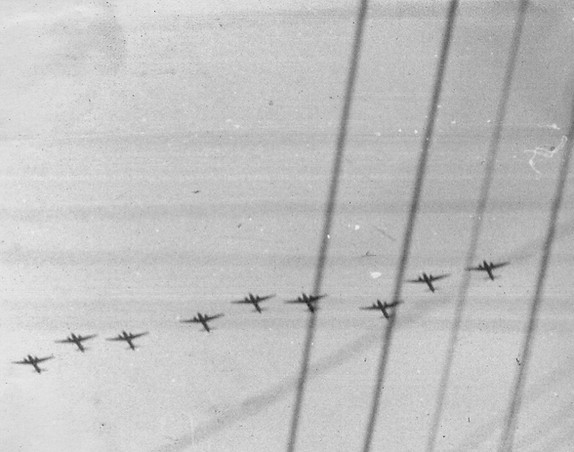
Photo by Eddie Aboitiz
Not long after, the American forces invaded and established airfields from which they could send fighter planes to patrol and hit targets of opportunity. Sometimes we would stand outside and witnessed aerial dogfights between Japanese and U.S. fighter planes. We would have daily patrols of usually four fighter planes flying around the city and the rest of the province. People in general would not move about in the open when these fighter planes were in the sky.
News from Manila started filtering into the community. We heard about the horrendous atrocities committed by the Japanese forces in Manila, before the American forces eventually annihilated them with this alarming news, people in Cebu started fleeing the city. We, the Morazas, who had sought refuge in front of the Redemptorist Convent, hatched a plan to leave Cebu via Talisay, then
travel on to Tubigon, Bohol on small outrigger sailboats locally called tumuran (sail driven outrigger boat).
Through a trusted man by the name of Pablo Cavan, we contracted two sailboats to meet us in Talisay on a certain day early in the morning. At the same time, with an undisclosed amount of genuine Philippine pesos and four sacks of unhusked rice, we were also able to secure from Cebu Governor Paulino Gullas a truck and driver to transport ourselves with whatever essential supplies we needed for the trip.
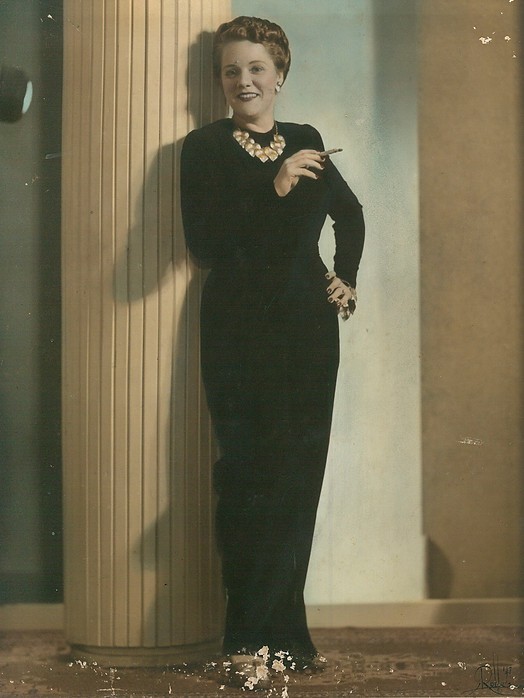
Rose McNearney Moraza
The day before our scheduled departure, the driver and the truck showed up at the neighbouring house where Joe (Peping) and his wife, Rose, lived. Rose was an American of Irish ancestry. All throughout the war she kept a low profile while living in Japanese-occupied Leyte and Cebu. Joe also worked in a commandeered ice plant, which the Japanese operated in Cebu for its army. The motive for his cooperation was so the Japanese military police, or kempetai as they were commonly known, would not look too closely on Rose who was passing herself off as an lrish National (lreland kept herself neutral all through-out the Second World War).
Nevertheless, Rose was a bundle of nerves all the time. The driver had been instructed to come to the house at four in the morning of our scheduled departure day, but he did not show up until six that morning. As if this was not nerve-wracking enough, we were soon to learn that nothing could have possibly prepared us for what lay ahead.
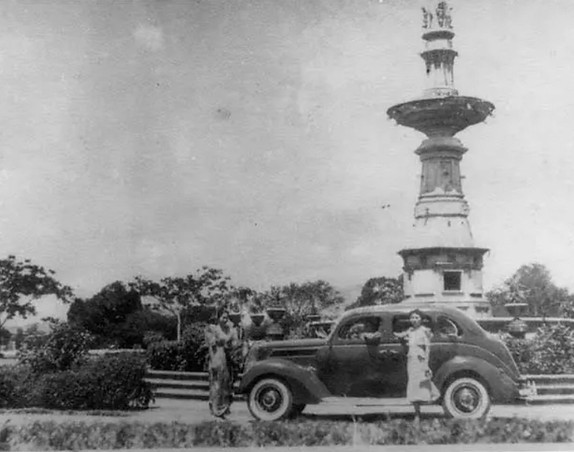
Fuente Osmeña, source: Sun Star.com
Since the truck was already loaded and all of us were ready to depart, we did not take long to get under way towards Talisay. By the time we passed Fuente Osmena on the road leading to the Cebu Provincial Capitol, the truck suddenly started to sputter, after labouring down the road, this truck that we were banking on to carry us out of the eye of danger took its last breath, and died. Efforts at trying to revive it were futile.
By that time, at seven in the morning, the sun was up and bright. At any moment, we were expecting the American fighter planes to show up. And our truck, loaded with all our possessions, would be an ideal target of opportunity.
The four U.S. fighter aircraft (or the "four musketeers", as we used to call them) were expected to show up at any moment. We all got down from the truck and frantically started pushing it, fully loaded as it was, back towards Fuente Osmena. We had to get the truck under a big mango tree in hopes that it would not be spotted by the U.S. patrolling aircraft. All the women and children scampered towards the bamboo groves nearby in order to get far away from the truck and out of view from the warplanes when and if they showed up.
We just managed to get the truck under a mango tree when the four American fighter planes appeared. While the aircraft circled overhead, Tomas the driver, Lucio, and myself took shelter in an empty concrete pillbox under the tree, which the Japanese had built in anticipation of a future invasion. The rest of the men went to join the women to calm their nerves by keeping them company.
After an hour or so, the drone of aircraft engines died down and disappeared. Obviously, they had departed from the area! With relief we resumed pushing the truck towards Joe's house and parked it underneath some huge mabolo trees.
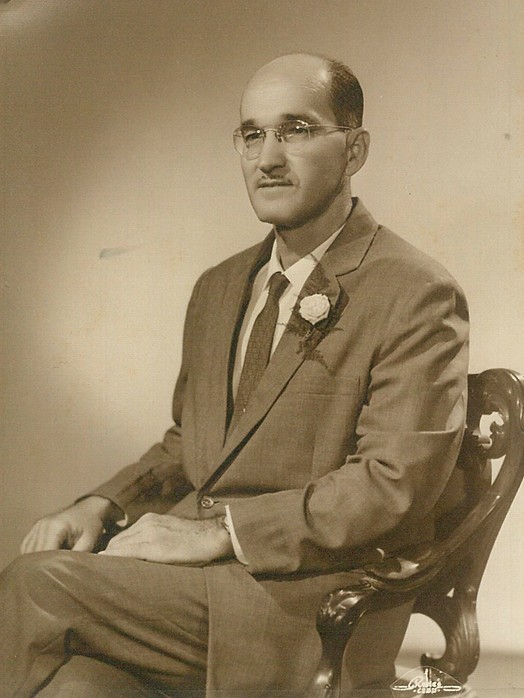
Joe Moraza
Joe, the excellent mechanic that he was, repaired the truck's defective fuel pump. When he opened it up, Joe discovered that the truck had been running on a truck tire inner tube for lack of a proper diaphragm. In the absence of anything better, Joe replaced the deteriorated makeshift diaphragm with the inner tube of another discarded tire. Rose, who by now had recovered from her flight, told Joe in her shrill voice: “Joe, let’s make sure that driver sleeps here tonight even if I have to twiddle his culito (little arse) all night.”
The following morning we all made a second attempt at going to Talisay. This time we started much earlier. The objective was to catch the sentries half asleep at their posts and nonchalantly drive the truck past them without stopping. We hoped and prayed that the sentries would think our vehicle was a Japanese military truck. That way if they happened to be alert enough when the truck passed, they would not dare shoot for fear of hitting one of their own. Imagine a truckload of white men, women and children, on a Japanese military truck travelling at a very early hour of the morning, driving towards the southern exit of the city; and with Rose and her American accent on board. I dreaded the thought of what could have happened if we had been stopped.
When we finally arrived in Talisay, Pablo Cavan was already there, waiting for us from the previous day. There was no time to tell him about our failure to show up on account of the truck's breakdown the day before. After hurriedly unloading our possessions into a long abandoned nipa storage shed and keeping everybody out of sight so as not to call too much attention to our presence, Pablo gave his report of what had happened the previous day.
It seemed that the day before, a group of Japanese soldiers had a picnic on the beach, got drunk, and forcibly got on the sailboats anchored offshore. Not knowing how to sail these boats themselves, one after another they all ended up capsized in the water. After the Japanese had abandoned the sailboats, their respective owners righted their capsized boats, bailed out the water and sailed away towards the nearby little islands. In other words, the boats that were to take us to safety were nowhere to be found. In the meantime several other families had arrived in Talisay looking for boats to transport them out of Cebu.
That same afternoon, one of the boats Pablo had contracted returned to Talisay. The boatman was swamped with offers of lucrative pay from people who wanted to get out of Talisay. But, the boatman was a man of honour. He declined all offers until he had had a chance to see the people who had contracted him the day before.
My father with Joe and lsidro concluded the contract to transport all of us with our belongings to a nearby island. Since not all of us with all our things could be transported in one boat, lt was agreed that the women and children with Joe and me would go on the first trip to the island of Mokabok. The boat would then return to Talisay immediately to fetch the rest of the family including the bulk of all our belongings.
If we thought the peril was over, it wasn't so. On that short trip to Mokabok, we were caught by a violent thunderstorm that tossed the boat like a cork. The sea was coming in as fast as we could bale the water out to keep the boat from sinking. Most of the children kept on crying and screaming with fear, while the older women were praying and imploring the heavens. lsidro's wife, Antonia, in one moment of despair, wrenched the gold necklace with the medal of the Sacred Heart of Jesus from her young daughter Maribel's neck and tossed it into the sea. But somehow, we managed to survive this agonizing experience, and we beached on the island of Mokabok that same afternoon. After unloading everybody and our meagre belongings, Joe immediately dispatched the boat back to Talisay to pick up the rest of our group.
The little island of Mokabok had just a few coconut trees and no source of fresh water to wash or drink. Fishermen and their families who lived off the sea populated the island. The people depended on water collected from rain or would fetch their fresh water from the mainland. The residents, however, were very friendly and hospitable. They readily offered to share their small nipa huts with us. Some of our women and children spent the night under the shelter of these huts while the rest of us slept on the beach under the stars. We were very fortunate it did not rain that evening.
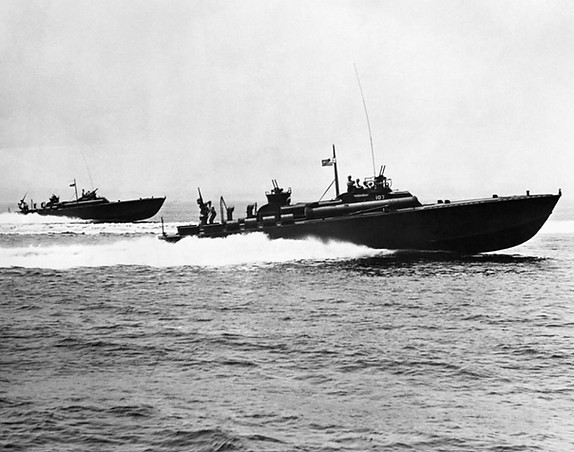
source: Fine Art America
That same night, my father, lsidro, and the rest of our group had a frightening experience while they were sailing towards Mokabok. While in transit, a flare suddenly lit the sky and pretty soon an American PT Boat suddenly appeared beside them. A PT boat is a US Navy high speed patrol boat armed with torpedoes and 50 calibre machine guns. The crew of the sailboat immediately lowered their sails and asked everybody on the boat to stand up and make themselves visible. My father, who because of his baldness always kept his head covered, was asked to remove his safari helmet so he would not be mistaken for a Japanese soldier. The P/T boat hovered beside them with its three powerful engines throbbing menacingly. Then a voice on a loud hailer demanded in the 'Cebuano' dialect: "Duna bai Hapon diha?" – “Are there any Japs on board"? To which the boatman replied. "Wala intaon nyor, tanan sibilian ning among sakay”. (No sir, all on board are civilians).
After they had been sufficiently reassured that there were no Japs on board, the PT Boat vanished from sight in one sudden burst of power. When everything was quiet, and everyone's nerves had calmed down, the sails were raised again and the small boat continued on to the island of Mokabok. They arrived past midnight, and after the excitement of their arrival and all the recent happenings recounted, we all settled down and slept on the beach.
We spent all of the following day chatting with the local population, drying our wet clothes, and the older men examining and finally contracting for a bigger sailboat to take us to Tubigon the following day. We left early and sailed on a bright sunny day with a stiff breeze blowing constantly. We arrived in Tubigon early in the afternoon of the same day. We immediately contacted some family friends from Cebu who had evacuated to Tubigon earlier and were already well settled in the town. The whole province of Bohol was free from Japanese troops. Everybody was in a festive mood, and the optimism that everyone would soon be able to return to their homes and live a normal life again sizzled in the air.
We stayed in Tubigon for about two or three weeks until the Morazas were able to negotiate a much bigger sailboat to transport us from Tubigon to Baybay. It was a two masted outrigger sailboat locally known as a banka, owned by Cresencio Richards and the two Garcia brothers, Bernardo and Pepe. On the trip to Baybay, Pepe Garcia came along as the person in charge of the vessel. We paid a total of PHP five hundred genuine Philippine pesos for the trip. For five days we sailed with no untoward event until the banka ran aground on a sandbank on the fifth night. Fortunately, amid barking orders and swearing in both Spanish and Cebuano from Pepe to his crew, they were able to pry the vessel free before the tide started to ebb. Many times we encountered dead calm with no breeze to even ripple the sails. It reminded me of the passage from The Rime Of The Ancient Mariner, which a portion went as follows:
As idle as a painted ship
On a painted ocean.
Water, water, everywhere,
And all the boards did shrink;
Water, water, everywhere,
nor any drop to drink.
Fortunately we had plenty of water to drink. After five days we finally got to the southern coast of
Leyte in a town called Inopakan. Some of our group were so sick and tired of travelling by boat, they decided to disembark and take their chances at hitch hiking on U.S. Army vehicles that would hopefully pass by. I was nursing an ulcer under the small toe on my right foot for close to one year then. Lack of medicine, poor nutrition, and no shoes were contributing factors, which made its cure
very slow and difficult. Walking barefoot on a gravel road was uncomfortable and oftentimes painful. I had fashioned myself a protective sole made out of a coconut husk which I wore all the time. It helped, but still, I figured it was better to stay on the boat until we got to Baybay.
At long last, we arrived in Baybay. Our clan immediately divided ourselves between the Aboitiz house on the beach, where Tio Jesus and his family lived and the house of our Tia Liling. She had never married, so her brothers and sister had unanimously agreed to award her the ancestral home of the Moraza family. A few weeks later, my family occupied the Escaño house by the beach. This was also the same house that had previously been used by the Japanese garrison. Across the estero was an old house owned by the heirs of Tio Manuel Moraza. Tia Martina, Joe, lsidro and Paquita were commonly referred to within family circles as Los Herederos (the heirs). Estero is the Spanish word for water easement influenced by tidal water from the sea.
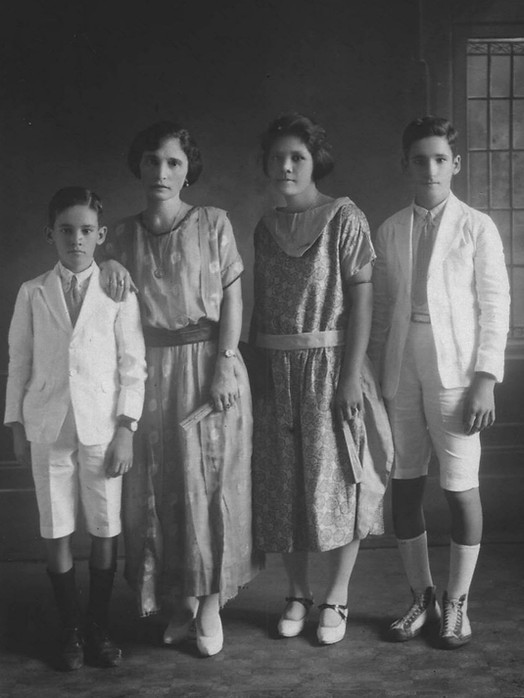
Isidro, Martina, Paquita, and Joe
While they were staying in Baybay, Joe and Isidro asked their Chinese tenants, Aling and Aboy, to move to the lower floor where they had operated a bakery for years. This allowed Tla Martina, her two sons,
Joe and lsidro, and their families, a place to stay on the top floor. These Herederos owned the town's electric power plant and ice plant. They also owned several farms and a bangus fish farm 4 kilometres south of Baybay proper. AII this and other assets were part of the legacy that Tio Manuel had left his family before he died at the young age of 49.
By then the American troops had conquered and occupied the whole island province of Leyte. The battles fought in Leyte left a lot of Japanese navy vessels sunken or beached around the Bay of Ormoc. The Japanese attempted to mount a counterattack against the American forces on the Eastern Coast of Leyte, which ended in disaster for the enemy. The Japanese had sent a naval taskforce to attempt to land troops and equipment in Ormoc, which was on the northeast coast of Leyte. However, the overwhelming power of the U.S. forces wiped out the Japanese counter offensive before they were able to land their troops and equipment. The Japanese were literally blown out of the water. Many Japanese soldiers managed to swim ashore but as they tried to reach the safety of the dense forest, they were machine gunned and bombed by continuous sorties of U.S. fighter aircraft.
According to my friend, Sabin Larrazabal, a few months after the smoke of war had cleared, if you walked or rode a horse among the tall grass growing on either side of the highway towards the mountains, you would hear the bones of the dead Japanese crunching beneath your feet or from the horse's hooves. My father then got into partnership with Francisco Sedigo to salvage a Japanese landing barge sunk off the beach in Ormoc. Francisco was originally from Bais, Negros Oriental and his father was the head foreman of Don Felix Montenegro's sugarcane farm Hacienda Kambuylao, in Bais, Negros Oriental. Antonio Sagardul had brought Francisco to Ormoc when he and Tio Guillermo Aboitiz were leasing and operating the Hacienda Maria Teresa. Francisco had become the head foreman of Hacienda Maria Teresa by the time my father assumed the management of the hacienda' then under Aboitiz & Co. control. Francisco and my father developed a close friendship and mutual respect for each other.
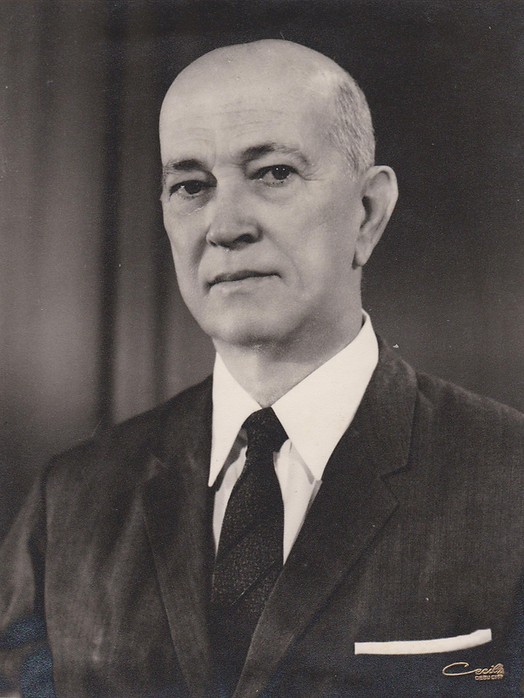
Fernando Moraza
Once this barge was afloat, it took a week to pole it all the way to Baybay, a distance of 40 kilometres along the shallow coastline. As soon as the barge was well beached at the mouth of the estero, work was immediately started under the direction of a machinist named Crispin. This was interesting to me, so I spent a lot of the time observing while this refurbishing activity was going on. The object was to convert this landing barge into a ferryboat to take passengers between Ormoc and Baybay. The road between these two towns was nothing but a dirt trail and almost impossible for a vehicle to get through.
Crispin took the engine and transmission apart and cleaned all the parts that were soaked in salt water. At the same time, a gang of labourers scraped and chipped the steel hull and sides of the barge and then painted the cleaned surfaces. My father also engaged the services of an old boat builder, named Emilio Alquino, to do the woodwork on the barge. Emilio had worked as one of Tio Manuel's boat builders in his younger days, having learned his trade under a Chinese master boat builder from Hong Kong, whom Tlo Manuel had employed to build his boats for the abaca and copra trade long before the war. This old man had a lot of interesting stories.
I also learned from Emilio the art of bending wooden planks by heating one side over a fire and slapping a wet rag on the other side of the plank. By means of wooden pegs driven into the ground to hold the wooden plank into its desired shape while the firing and wet rag slapping was going on, the plank would eventually retain its intended shape'
Francisco Sedigo sent his son, Salvador, from Ormoc to help in the re-fitting operation of the boat. Salvador was my age and stayed in our house sharing my room while in Baybay. My father employed Salvador as a courier and messenger to obtain spare parts from Ormoc when needed. There were many enterprising mechanics in Ormoc who would dive and salvage parts such as injection pumps' lnjectors,and starter motors,etc.,from the myriad of Japanese landing barges
sunk and strewn on the coast. It was from these salvagers that we would procure the spare parts needed.
Not long after we had arrived in Baybay, lsidro’s wife, Antonia, gave birth to their second son, Jose
Mari Moraza. Dr.Jose Silao attended to Antonia during her pregnancy and eventual delivery at our
house. My mother, who was a frustrated nurse herself, looked after Antonia and the newly born baby. As expected, my mother became the baby's godmother in baptism.
Baybay became a favourite rest and recreation (R & R) place for the American troops. On weekends, the town would flourish with both Afro-American and Caucasian U.S. soldiers. The once sleepy town came alive with nightclubs and bordellos catering to the needs and sexual appetites of the U.S. service personnel. There was also a booming trade in souvenirs and army issued goods between the civilian population and the U.S. enlisted men and officers alike. The most popular souvenirs consisted of bolo knives of different sizes and shapes with fancy wooden handles and bone-inlaid scabbards although most of the time, the blades were fashioned from any ordinary piece of well-polished steel.
There were also brightly coloured grass or abaca fibre table place mats and napkins, etc., which in my opinion, was nothing but cheap rubbish. The Americans, however, found them very attractive. In exchange for these souvenirs the Americans would offer G.l. army issue woollen blankets, olive drab bed sheets, towels, socks, combat boots and shoes, cigarettes, etc. Even army issue canned goods such as ham, sausages, butter, powdered eggs, etc., were traded in the open market. All felt that the war's deprivations had come to an end.
One day, the Varela brothers, Leonardo, Pedro, and Ramon, showed up in Baybay. They had just come from Ormoc and were dressed in U.S. army clothes and were carrying Japanese pistols holstered around their chests. I am sure they came to see me mainly to show off and brag about their life with the U.S. soldiers. As interpreters, the brothers went out on patrols with U.S. troops hunting for Japanese stragglers. They tried to convince me to join them. I was sorely tempted and green with envy, however my father vehemently opposed the idea.
One of the most interesting stories they told was of how a Japanese sniper threw a hand grenade at them on one of these patrols, and how a piece of shrapnel cut into Pedro's penis almost severing it in half. He was rushed to the field hospital in Baybay where his wound was treated and his penis (thankfully) saved. Thanks to the Japanese sniper, the casualty had left a magnificent scar Pedro’s manhood, which became a great asset to his love life in later years.
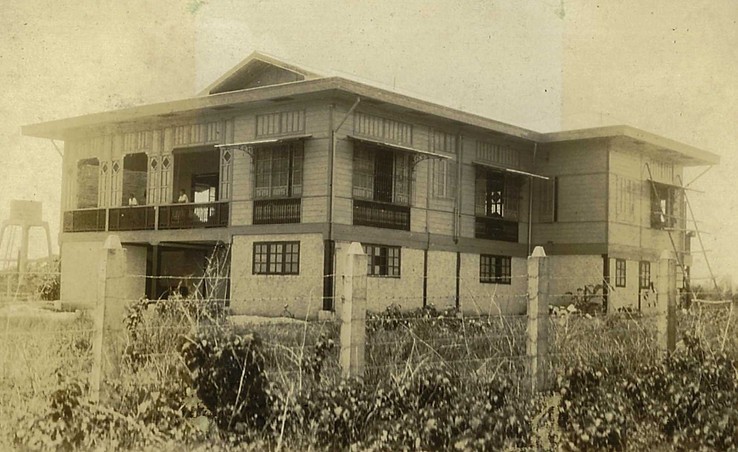
Hacienda Maria Teresa
One day, the war did end; and with that, the sugar industry was revived all over the Philippines, including Ormoc. The sugarcane haciendas were being cleared of the wild vegetation that had grown after more than four years of unproductive abandon during the war. The fields were ploughed and planted to sugarcane and the sugar mills were rehabilitated to make them ready for milling the sugarcane crop in one year's time. My father decided to move back to Ormoc and resume the management of the Hda. Maria Teresa.
My father had to live temporarily with Juana Palou in her house. This was one of the few houses that had been spared from the general destruction of Ormoc during the battle of Leyte. The pre-war residential house of the hacienda was completely burned and destroyed. My father built a temporary structure on the original concrete slab, using salvaged corrugated iron roofing for walls, nipa shingles for the roof, and hand-sawn timber for the first floor. This is where we were to live in the meantime.
When we left Baybay and went back to Ormoc, it was also the last time I saw Mary. Eventually Uncle Jesus' family moved back to Cebu as well. Mary also left the household of Tia Pepita, her half-sister, and continued her schooling independently on her own. We used to write to each other occasionally even then I was already in the U.S. Over the years my strong affection for Mary also waned to the stage when our correspondence also came to a stop.
Mary eventually got married some time later and so did l. lt was not until about forty years later that we met each other during a family gathering in the beach in Liloan, Cebu. To my great shame and embarrassment, I did not even recognise my former heartthrob.
Comments
