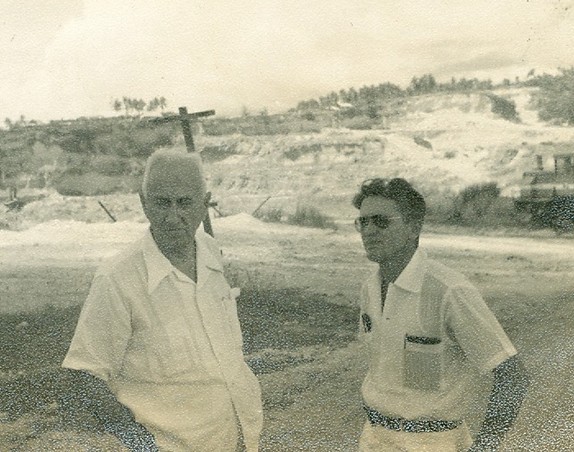
Surviving the War
An excerpt from "The Family & Firm"
Aboitiz & Co. was involved in the war effort from the time the Americans first began to mobilize the Philippines defense. The United States commandeered vessels of La Naviera Filipina in 1941 to transport troops and supplies. Don Ramon was put in charge of shipping at no compensation and he also served for a short time as Rice Controller procuring rice from the provinces. The price of rice had risen sky-high with the disruption of transport but he was able to reduce it by half. Other family members were drawn into the war preparations as well. Eduardo Aboitiz volunteered as a civilian worker for the U.S. Quartermaster Depot where he served as assistant to the Procurement Officer. Jose (Peping, also known as Joe) Moraza, Manuel’s oldest son, who had been an engineer with La Naviera Filipina, helped the U.S. Army Transportation Corps in recruiting crewmembers and sourcing food supplies.
Despite these services, the assets of Aboitiz & Co. were frozen in July 1941, along with all Japanese assets in the U.S. territories, by order of the U.S. Secretary of Treasury. The assets of Hoa Hin, the shipyard, and even Lim Tian Teng were similarly embargoed. It is not clear what the grounds were for the action against Aboitiz. It was speculated that it was because the company had a Japanese director on its Board (although Ramon noted that many other Cebu firms had an employed Japanese and where not touched) or that the company had shipped copra to Russia (even though the shipment had been approved by the proper authorities). Despite the witness of Captain C.J. Martin and other American residents in Cebu testifying to Aboitiz’s loyalty to America, the embargo remained. However, the company continued to do business until the Japanese invasion but this had to be carried out outside the banking system.
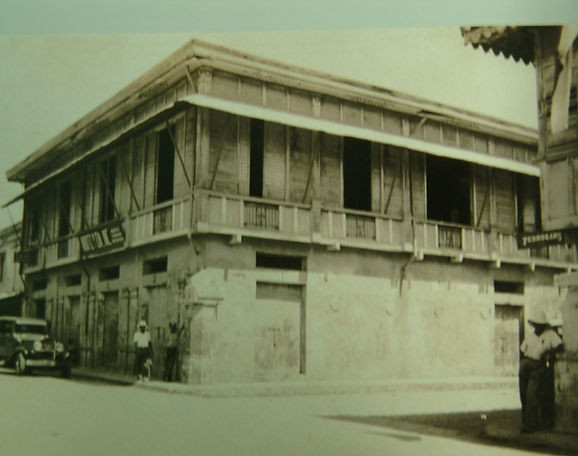
Aboitiz & Co. 1934
The Japanese occupation of the country (1942-1945) challenged the company’s capacity to persist and survive.
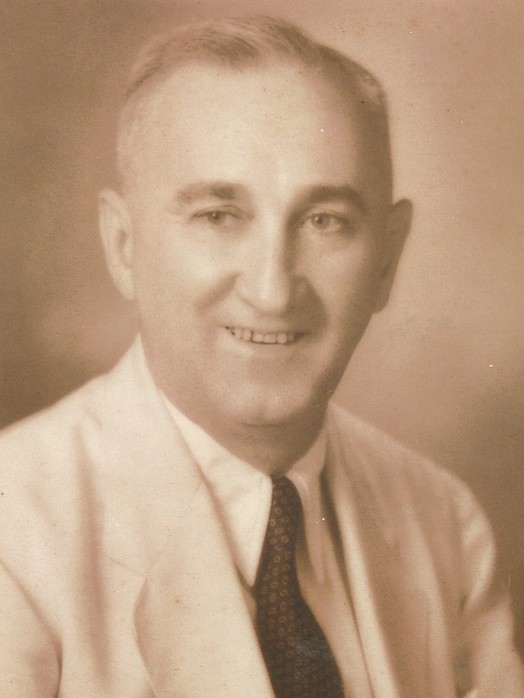
Ramon Aboitiz
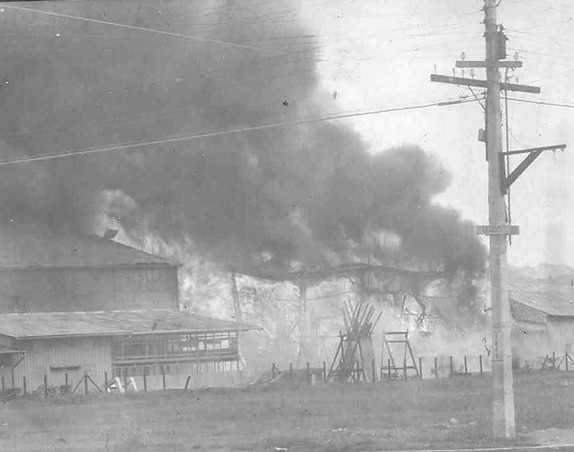
Photo by Eddie Aboitiz
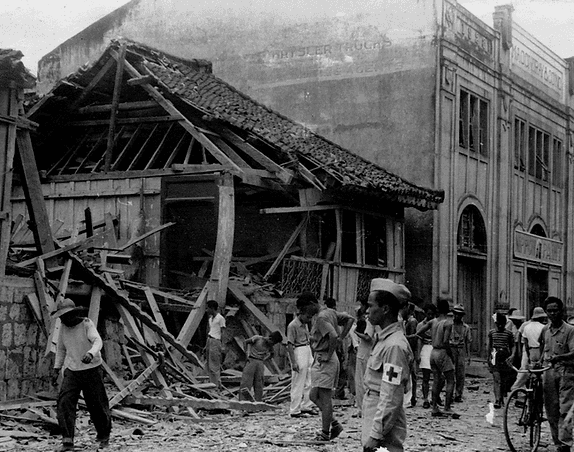
The Japanese invaded Cebu on 10 April 1942, landing troops in Pinamanguhan on the west coast of Cebu and Talisay just south of the city. On the eve of the Japanese landing, the Americans, in a bid to deny supplies to the enemy, burned supplies, ammunition, and facilities in the pier area, destroying an area six or seven blocks in length along the waterfront from the Customs House to Carbon Market. In the process, a good portion of Cebu’s commercial district was destroyed. Fed by exploding ammunition, the fire blazed for more than a week, destroying the water main in its wake.
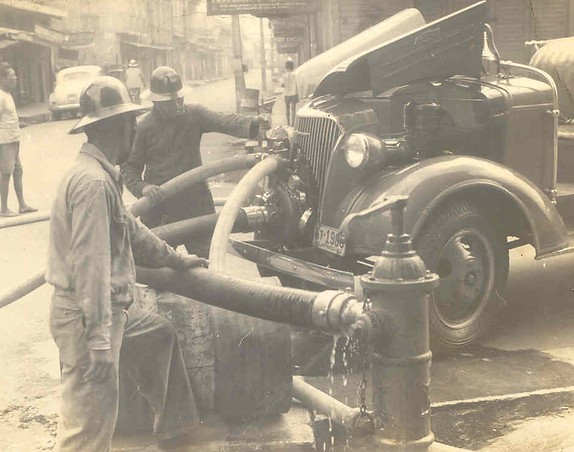
Photo by Eddie Aboitiz
There was little resistance as the Japanese troops entered the smothering city. Many of Cebu’s citizens had fled by this time, taking up residence in the interior or in the other islands. Ramon, Vidal, and others in the Aboitiz family stayed in the city, although some evacuated their families. Ramon and Vidal worked in the office until the day the Japanese landed. Their faithful secretary, Alay, was on her way to work that morning when she saw people fleeing before the troops, and she finally left the city herself.
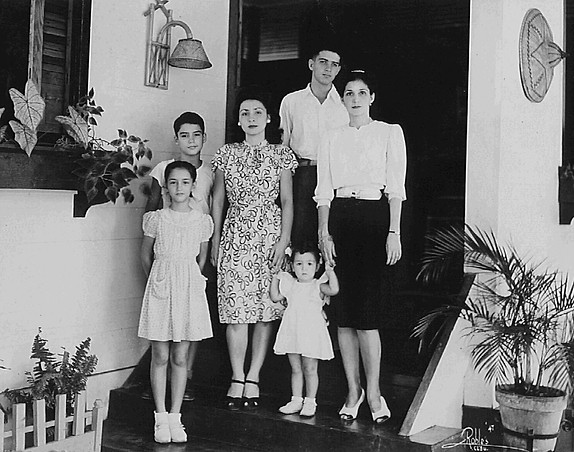
Luis Aboitiz Family: Cely with Ernie behind her, Josephine and Maria holding Vicki’s hand, Louie behind Mango Avenue, 1948
It was, for the family, a time of great anxiety since the war found family members scattered in Cebu, Leyte, and Manila. The Ugartes were in Manila and some of the Moraza’s were in Leyte. It was also in Leyte that the Bowler family sought refuge until they found their way back to the United States as the war ended. Luis Aboitiz and his family, who had gone to Baybay sometime in January 1942, returned to Cebu just a few weeks before the Japanese landing south of the city. They remained in the city until January 1945, shortly before the return of the Americans, when they took a hazardous trip by sailboat from Cebu to Bohol, and then on to Baybay, a roundabout journey that took them several days to complete. They eventually returned to Cebu only to find their house on Gorordo Avenue (at the present site of Asilo de la Milagros) destroyed in the battle that came with the American liberation in the city.
With business at a standstill, everyone tried to make a living as best he could. Buy-and-sell was the order of the day. With commercial stocks almost nil, the major source of consumer goods were the stock of the US Quartermaster Depot. The depot had been set up in Cebu before the war broke out and it became the major army depot as those in Luzon were evacuated. Two supply ships from Australia had come in with supplies and the second ship had been partially unloaded when the Japanese took Cebu. The supplies were stored in a cache in mountains behind Cebu city and were sizeable enough to last out the war. Local villagers claimed these goods after the surrender of the USAFFE troops.
Canned foods, medicines, and various products formed the bulk of the depot’s supplies. The villagers brought the goods down from the mountain to the surrounding barrios. Cebu’s merchants met daily to haggle and buy the crates. The interior location of the trading area made it relatively safe from Japanese incursions. Moreover, the guerrillas had organized in the mountains and they made it unsafe for the Japanese to venture outside the city. Don Ramon himself, then 55 years old, participated in this informal trade, joining other merchants who used bicycles to transport goods to sell to boticas (pharmacies), sari-sari stores, and other retail outlets.
The Japanese printed their own currency, which came to be known as “Mickey Mouse” money. With communication networks down though out the country and normal distribution channels for food and other goods all but non-existent at first, the value of the Japanese money rapidly deteriorated. Goods passed from hand to hand within the city, appreciating in value simply by being held.
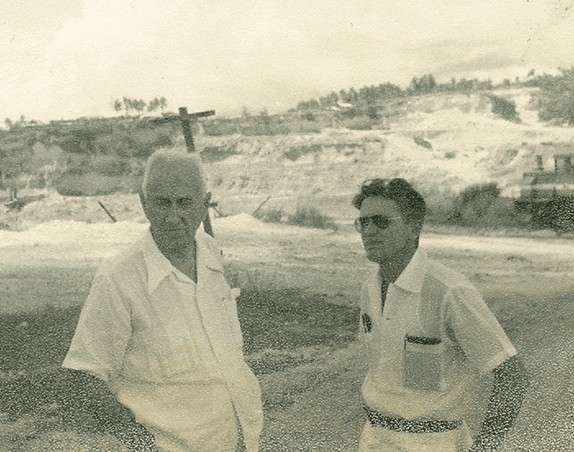
Ramon Aboitiz and son Eddie Aboitiz, Jolo
While many paid their pre-war debts in the useless currency, barter became the only means of the Aboitiz family to participate in the petty buy-and-sell trade. Like other businessmen, they were reduced by the war to primitive forms of enterprise. Don Ramon paid in kind for the services of the few employees who continued to work for him. The employees in turn sold the goods to buy their necessities. Each one of them had his “specialty” with Eddie, for instance, dealing in medicines while others were given custom jewelry to peddle. The center of activity was the first floor of Don Vidal’s large Spanish-style house in Ranudo St., which served as warehouse and office throughout the war.
It was a difficult time for the Aboitiz and for Spaniards or Filipinos of Spanish descent, given Generalissimo Francisco Franco’s sympathy for Japan and the Axis powers. Being Basques, however, the Aboitiz had little sympathy for Franco. The Aboitiz had cast their lot with the Filipinos but, they had to steer clear of wartime politics. Don Ramon tried to help his American and British friends who had been rounded up by the Japanese and quartered in the premises of the U.P. Junior College and Club Filipino in Cebu. With the restriction imposed by the Japanese, however, there was only so much that could be done.
The scarcity of food and cash eventually led Don Ramon to hazard a trip to Manila to visit the company factory and wholesale grocery store in the capital to see what could be brought back. Travelling to Bogo in northern Cebu, several months after the Japanese occupied the city, he boarded a sailboat that belonged to Mrs. Mercedes Moras. Loading the small sailboat with local produce to sell in Manila, he and several others embarked on a harrowing 12-day trip through often rough seas that took them to Masbate, Bulacan, Sorsogon, and finally Batangas. The travellers met several mishaps, including getting lost along the way. From Batangas, they got a truck to take them to Manila, which they were able to enter only after presenting the proper passes at Japanese checkpoints.
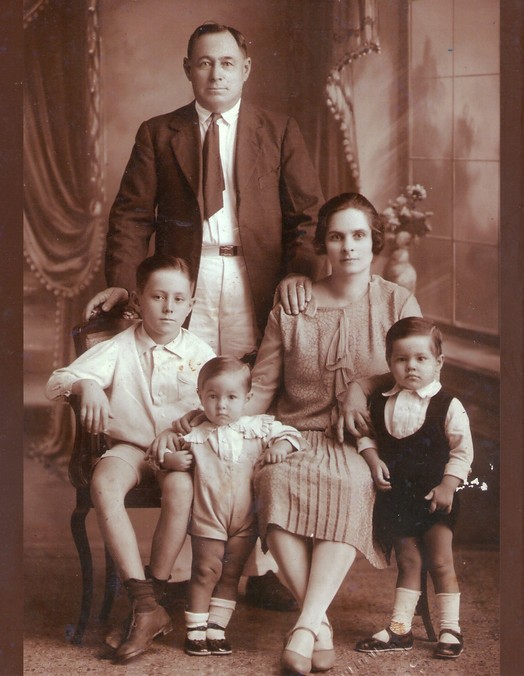
Juan Ugarte and Dolores Aboitiz with their three sons: Paulino, Mario, and Juanito
Don Ramon’s visit buoyed the morale of family members who were caught by the war in Manila. These included the Ugartes – the families of Ramon’s sisters, Ana (Anita) and Dolores (Lola) – and the family of the late Paulino Aboitiz, Jr. Paulino’s young widow, Clemencia, and her four children (the eldest of whom was only 15 at the time). They had left their house in Malate to seek refuge with the Ugartes, who lived in a compound on Guevarra St. in San Juan. Though an American citizen, Clemencia had escaped internment through the help of Assemblyman Dominador Tan of Leyte, a close friend of Paulino, who procured for her false Filipino residence certificate papers.
During the brief visit, Ramon stayed with the Ugartes in San Juan. He stocked up on as much food from the grocery store and clothing from the knitting factory as he could, besides securing P10, 000 in prewar currency.
With some companions, Ramon made his way back to Cebu in a voyage that took only 10 days though they had to stop on the island of Ticao when they ran out of food. Here Don Ramon tapped the hospitality of a rancher-friend, who promptly butchered a cow and made tapa (jerked meat) for them. Arriving in Bogo, they filled a truck with the sailboat’s cargo and proceeded to Cebu City. They had to pass a Japanese checkpoint in Danao City, halfway to Cebu, Don Ramon, with characteristic deliberation, hid the P10, 000 at the bottom of a bag of dried fish (bulad). Placing the bag conspicuously in the front of the truck, he rode confidently up to the Japanese guard. The bag attracted the guard’s attention but when he opened it to check its contents, the strong smell of dried fish kept him from investigating further. Ramon’s bet had worked.
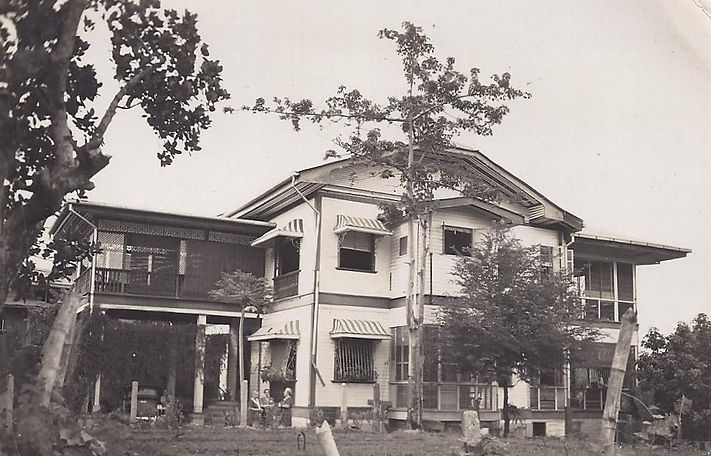
House of Ramon and Lolita Aboitiz
The Aboitiz had several other brushes with the Japanese. The Japanese kempeitai had originally been quartered on the campus of the Cebu Normal School and had an office in the Presbyterian compound on Jones Avenue. Guerrilla attacks on the buildings prompted them to spread out, and the soldiers bunked down in various choice residences in the city. Ramon’s spacious house on Elizabeth Pond St. was chosen by some of the officers as their headquarters. Hardly a quarrelsome man in the face of such circumstances, Don Ramon calmly moved his family upstairs.
Don Ramon continued to go about his business as usual. The Japanese harassed him at first, knowing of his assistance to the foreign interns as well as his civilian role with the U.S. Armed Forces the year before.
“But when they saw that I didn’t go out much and only visited my brothers and a few friends, they left me alone,” he recalled. Home life for the family was spartan and subdued. To help feed the household, they kept a few chickens, cultivated a small garden, and had a cow and a carabao at various times.
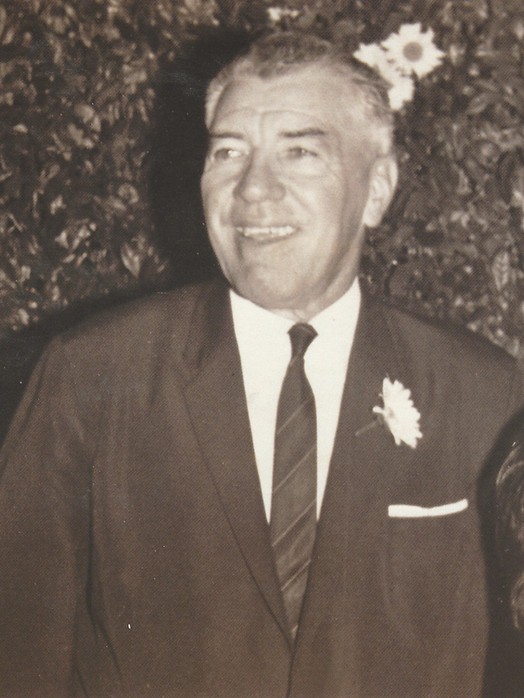
Mariano Gonzalez
In Manila, the Japanese had come in peacefully and there was less destruction as in Cebu. Business went on as usual, except that the market had shrunk to the limits of the city and no new stocks were arriving. The Aboitiz & Co. wholesale grocery was a run by a Spaniard who, as Don Ramon learned on his trip to Manila, was paying more attention to his own business than to the company’s. A Board of Directors’ meeting in Vidal’s house on 26 December 1942 gave Mariano Gonzalez a power of attorney to run the Manila office, and he was promptly dispatched to take over. Ramon Zabaleta, who had been moved from the Aboitiz office in Cebu to Manila before the war, continued in the Manila office to help Mariano. They and Jesus Moraza, who was managing the West Leyte Transportation Company in Baybay, were thus the only Aboitiz executives on the company’s payroll during the war.
The grocery department had substantial stocks in its large Intramuros warehouse when the war broke. The food stock lasted throughout the war but had to be traded discreetly, given the wartime conditions. The Manila Knitting Factory, which operated for most of the Japanese occupation, continued to produce two items: socks and undershirts. The liquor business was good, and the Aboitiz even bottled olive oil before the war. Mariano Gonzalez did not dare send any of the rum to Cebu, even after the Japanese boats began to make regular Manila-Cebu trips in the later part of the war. “It would have been the first article seized and consumed by the Japanese,” Mariano noted.
The foreign interns had been transferred to the Santo Tomas compound midway through the war, and Don Ramon instructed Mariano Gonzalez and Ramon Zabaleta to help them out as much as they could. At the risk of life and goods, they brought food, clothing, and medicines (and even Philippine pesos) to the compound. Sometimes the Japanese let them through, sometimes not. For its humanitarian assistance, the American Red Cross commended the company after the war.
Such was the inflated value of consumer goods towards the end of the war that the company was offered a large part of land in exchange for 1, 000 cases of liquor. On the last day of the war, Japanese P50 and P100 bills floated freely in the breeze. So little were they valued, no one bothered to retrieve them. (Japanese war notes plunged in value to as low as 120 Japanese pesos to one prewar Philippine pesos at the end of 1944.)
As the Americans were about to land in Leyte, the Aboitiz officers saw the value of their liquor stocks in Manila. With a liberating army in sight and goods at a premium, they had the stocks of liquor moved to the suburbs, to the compound of the knitting factory in San Juan. It was with considerable dismay then that they watched the Japanese set up an anti-aircraft battery right next to the compound. The area automatically became a target for American bombers, whose wide aim soon destroyed: the Aboitiz house in Malate, the knitting factory, and the Intramuros store and offices.
Few assets remained. Their ships had been commandeered. Both armies destroyed the power plants in Mindanao. The Masbate ranch had been successively raided by Japanese, guerrillas, and thieves. In Cebu, the Juan Luna office, hardware store, and ice plant were destroyed by American bombers and the machine shops were burned early in the war.
Yet, the war proved the ultimate wisdom of Don Ramon’s strategy of diversification. Two of the company’s business had continued to function and earn an income throughout the war years, while others were to provide footholds for rebuilding in the ensuing years.
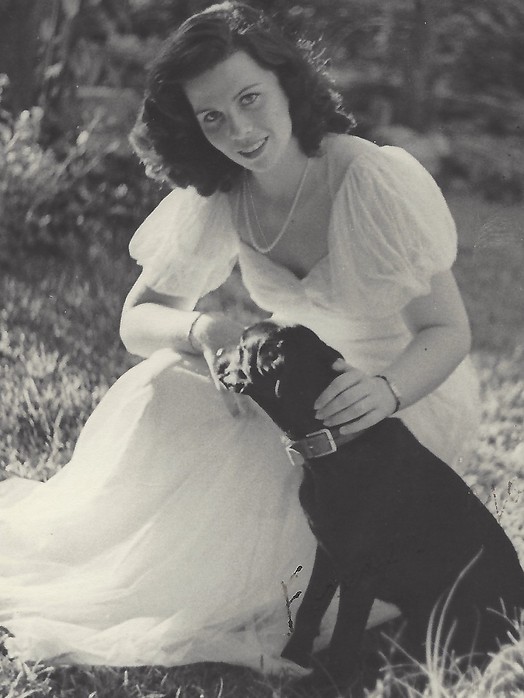
Maria Luisa Aboitiz Canova in her mid-teens. Photo taken by her brother, Eddie Aboitiz
As MacArthur led his troops into Leyte on 20 December 1944 and American bombers filled the skies, the Japanese in Cebu held firm. Six months later, however, the American forces landed in Talisay and the Japanese fled just as the American forces did earlier. Before leaving, they took care of unfinished business. Collaborators were summarily shot and fire consumed thousands of homes and businesses (including the house of Don Luis on Gorordo Avenue). Don Ramon’s daughter, Maria Luisa, had put her hope chest in the nearby St. Theresa’s School, fearful that their house on Elizabeth Pond would be destroyed. As it turned out, the Japanese officer-in-charge (who had lived in Don Ramon’s house) had left word that the house was not to be burned. It stood alone, unscathed, as most of the neighborhood, including the school, burned.
Rebuilding the Company
The war left Cebu devastated. The city’s commercial section was completely leveled by the American bombing, with the historic Santo Niño Church and Magellan’s Kiosk left standing. Residents wandered through the rubble, so disoriented they could not distinguish streets or locate familiar landmarks.
Individuals and companies set about rebuilding. With their offices on Juan Luna St. destroyed, Aboitiz & Co. continued to do business in Don Vidal’s house. Meanwhile, a makeshift two-story company building was constructed in place of the old one. Made of flattened oil drums and scavenged lumber, it was a monstrously hot place to work in but served a function for several years. Other businesses operated under similar conditions. In the days after the war, the Smith Bell office in Cebu consisted of just a single desk in the firm’s partially destroyed warehouse. In place of a strong room and safe, its manager, H.V. Jones, had to put the firm’s cash, often in large quantities, under his pillow at night in the small hotel he lived in.
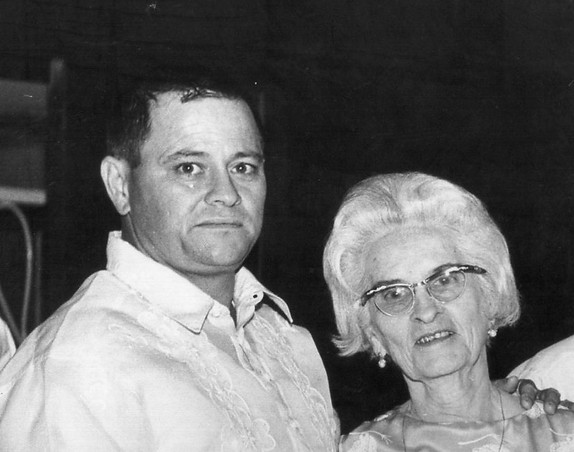
Juanito Ugarte and his mother Dolores (Lola) Aboitiz Ugarte
In Manila, the destruction was so severe that people had to rebuild from scratch. Mariano Gonzalez and Ramon Zabaleta had, during the occupation, ferreted away a cargo truck which escaped Japanese confiscation because they had disassembled it, hiding tires, wheels, engine, and other parts in various locations. The war over, they put it back together again and had it running. Xavier (Xabi) Aboitiz, Paulino’s son, who was in his teens at the time, recalls the times he, Juanito Ugarte (Juan Ugarte’s son), and a driver named Braulio drove the truck to San Fernando, Pampanga, where they would buy just about anything that could be traded (rice, corn, tinned food) and then ferry the goods back to Azcarraga in Manila where Zabaleta had set up a “store” out of a makeshift shelter of salvaged galvanized iron sheets. Out of such primitive beginnings, Aboitiz began its postwar business operation in Manila.
In Cebu, there were some assets that were left that Aboitiz could draw on to start again. The shipyard entered into a contract with the U.S. Navy in June 1945 and the latter had full use of the area for the next two years, employing over 700 people in the furious attempt to repair its vessels. The Tagbilaran of Cebu-Bohol Ferry turned up surprisingly washed ashore near Mabolo, just outside the city, and, after a few repairs, was pressed into service, one of the first commercial vessels to resume operation in the Visayas. As it brought income into the firm, it became, for a time, the vaca lechera (cash cow) for any and all needs of the company.
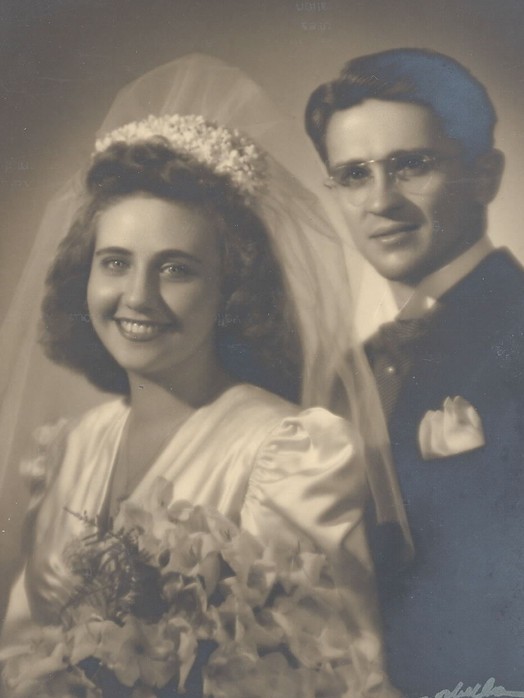
Francisca “Paqui” Melendez and Eddie Aboitiz
Don Ramon leased a small J-boat for P5 a day, and put it in the run between Opon and Cebu. The ferry generated “a lot of money,” Don Ramon recalled. Eddie Aboitiz himself had a stock of bottled liquor after the war and made money supplying the American G.I.s. He shortly left for Spain for a well-deserved vacation, returning to the Philippines in 1947 with his vivacious Spanish bride, Francisca “Paqui” Melendez.
In Leyte, the Aboitiz were able to rehabilitate two trucks of the West Leyte Transportation Co., which they salvaged from the war. They attempted to resume their crop trading activities but high costs and the lack of interisland transportation rendered trading extremely difficult, if not impractical, in the months right after the war.
The Aboitiz held one last ace in their hand. When the American army was in Cebu before the Japanese occupation, they bought a good quantity of goods from Hoa Hin Hardware. They left before paying, but Don Ramon had put the sales invoices in the hardware store’s safe for the future collection. They were still there when the Japanese occupied the city. Fearful that the Japanese soldiers would ransack the place, as they in fact did, Don Ramon decided to move the invoices to the safety of his residence. Capitalizing on the loyalty of one of his former Japanese employees, he asked the latter to go to the hardware store and retrieve the bills for him. This fellow was able to get by the Japanese guards stationed outside the store and returned with the papers. The bills worth P300, 000, was collected after the war and provided the capital needed by the Aboitiz brothers to get started again.
The postwar rebuilding was also greatly aided by U.S. War Damage payments. For many companies, rehabilitations took five years in most cases and longer in others.
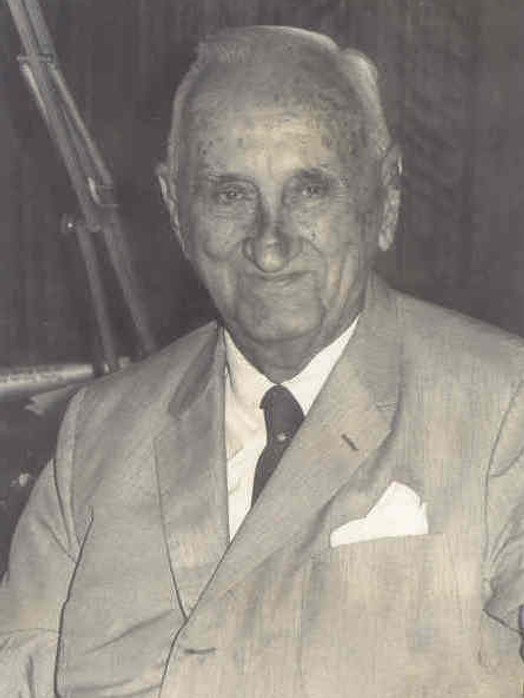
Ramon Aboitiz
The times were not easy and there were moments right after the war when the indefatigable felt like giving up. In letters to William Bowler (who had gone back to the United States), Don Ramon wrote in 1945 that, while he believed that the company still had a future, much depended on the commitment and dedication of the other members of the family, particularly the younger partners in the company. He felt he had invested more than enough of his time and energy on the company and that he deserved to enjoy his last remaining years in retirement. To Bowler, he wrote on 28 July 1945:
Yo por mi parte estoy decidido a retirarme porque he trabajado ya bastante en mi vida para el bien de Aboitiz y Cia. Inc. y de aqui en adelante tengo que mirar por Ramon Aboitiz por los pocos años que tengo que vivir. El futuro de la Compania depende de los socios jovenes si quieren o estan dispuestos a sacarlo avante. Ya estare solo el tiempo suficiente para ponerlo en marcha y si queda algo retirarme.
[“As for me, I am decided to retire myself because I have worked enough in my life for the good of Aboitiz & Co., Inc., and from now on I have to look after Ramon Aboitiz in the few years left for me to live. The future of the company depends on the young partners, if they desire or are prepared to move forward. I will stay only for the time needed to put things in motion and then I shall retire.”]
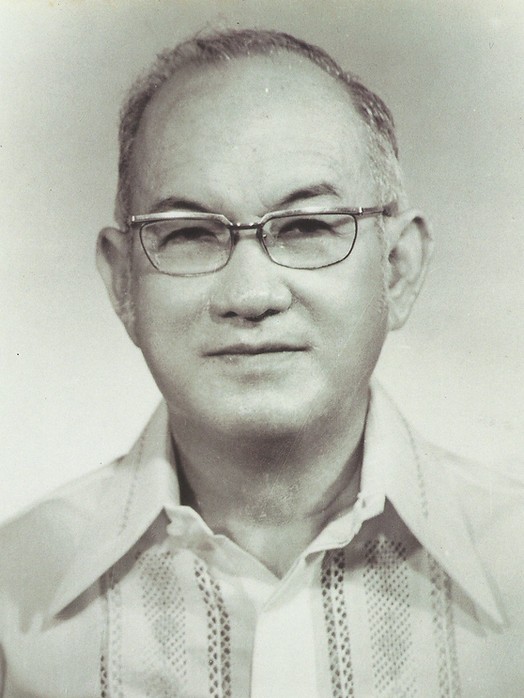
Bill Bowler
As it turned out, Don Ramon was not one to resist a challenge. He proceeded to regroup the prewar officers and men of the company. (Among those the company lost during the war was Joaquin Yrastorza, who died in Ormoc.) In 1945, he reestablished contact with Bowler, who had remained in the United States to take up residence in California. Such was Bill’s faith in the company, and his love for Cebu that he decided to return to the Philippines even though some of his children had decided to stay on in the U.S. Don Ramon also recruited new managers. Two important additions to the company in the immediate postwar years were William (Bill) A. Paradies in 1946 and Edson H. Canova, Don Ramon’s American son-in-law, in 1947.
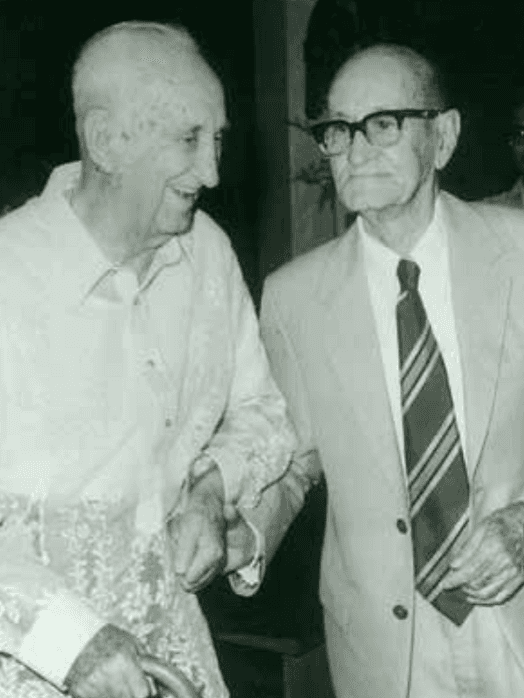
Brothers Ramon and Vidal Aboitiz, 1970s
Most of the business took time to develop in the immediate postwar period. Aboitiz established its position in shipping, marketing, power distribution, banking, and its mother business of export trading. Building on the company’s entrepreneurial tradition. Aboitiz & Co. resumed the work of expansion and diversification it started in the prewar period, and brought it to an even higher level. In this effort, Ramon and Vidal were by assisted by the third-generation members of the Aboitiz and Moraza families.
Comments
